NATIONAL INSTRUMENTS USB-8502 Port Can/can
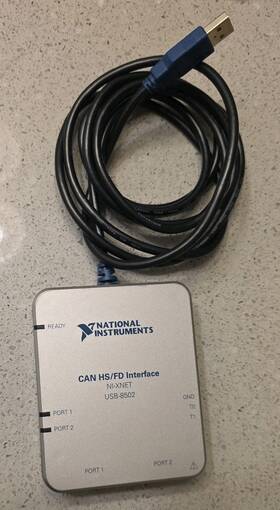
( Brand: National Instruments ), ( Manufacturer Part Number: USB-8502 ), ( Country Of Origin: China )
Review NATIONAL INSTRUMENTS Port Can/can Fd Fast Shipping
The **National USB-8502** is a high-performance, industrial-grade USB-to-CAN (Controller Area Network) interface module designed to bridge modern computing systems with robust automotive, industrial, and embedded CAN bus networks. Engineered for reliability and versatility, this device supports both **CAN 2.0A/B** protocols at data rates up to **1 Mbps**, making it ideal for applications requiring seamless communication between CAN-based devices and USB-connected computers, PLCs, or data acquisition systems. Its compact yet durable form factor, featuring a **D-sub 9-pin connector**, ensures compatibility with a wide range of CAN bus systems while providing a secure and stable connection. The USB-8502 operates under **Windows, Linux, and macOS** environments, leveraging industry-standard drivers and APIs to simplify integration into custom applications, test equipment, or monitoring solutions. With built-in **bit-rate auto-detection** and **CAN bus monitoring capabilities**, this module allows users to diagnose network issues, log data streams, or interface with CAN-compatible devices with minimal configuration. Its **isolated design** (up to **500V DC isolation**) enhances safety in industrial environments by protecting sensitive equipment from voltage spikes and ground loops, while its **low-latency performance** ensures real-time data transmission critical for automotive diagnostics, motor control, or industrial automation. Whether used for development, testing, or field deployment, the USB-8502 delivers a balance of flexibility, durability, and ease of use, making it an essential tool for engineers, developers, and technicians working with CAN-based systems.
**Pros and Cons of buying a National Instruments USB-8502 (DAQ Device)**
The **National Instruments USB-8502** is a versatile data acquisition (DAQ) device designed for analog input, digital I/O, and counter/timer applications. Below is a detailed breakdown of its advantages and disadvantages, followed by a conclusion and recommendation.
---
### **Pros of the USB-8502**
1. **High-Speed Analog Inputs**
The device offers **16 single-ended or 8 differential analog inputs** with a **250 kS/s** sampling rate per channel, making it suitable for medium-speed data acquisition tasks such as sensor monitoring, vibration analysis, or basic signal processing.
2. **Digital I/O Capabilities**
It includes **8 lines of digital I/O**, which can be used for control signals, status monitoring, or interfacing with relays, switches, or other digital devices. This flexibility is useful for automation and testing applications.
3. **Counter/Timer Functionality**
The built-in **2-channel counter/timer** allows for precise timing measurements, pulse counting, or frequency measurement. This is valuable for applications like motor control, speed monitoring, or event timing.
4. **Plug-and-Play USB 2.0 Interface**
The device connects via **USB 2.0**, which is widely compatible with most computers without requiring additional drivers (though NI s software is still needed for full functionality). This makes setup relatively straightforward compared to PCI or PCIe alternatives.
5. **Software Compatibility with LabVIEW and NI-DAQmx**
The USB-8502 is fully supported by **LabVIEW** (NI s graphical programming environment) and **NI-DAQmx**, a robust driver suite that simplifies data acquisition tasks. This integration is ideal for engineers and researchers working with NI s ecosystem.
6. **Compact and Portable Design**
As a **USB-based device**, it is more portable than PCI-based alternatives, making it suitable for field testing, educational labs, or applications where space is limited.
7. **Cost-Effective for Entry-Level Applications**
Compared to higher-end DAQ devices (e.g., those with 1 MS/s sampling rates or more channels), the USB-8502 offers a **balanced performance-to-price ratio**, making it accessible for hobbyists, students, and small-scale industrial applications.
8. **Low Latency and Reliability**
For its class, the USB-8502 provides **low latency** in data acquisition, which is important for real-time monitoring applications. NI s hardware is generally reliable, with a reputation for durability in laboratory and industrial settings.
9. **Extensive Documentation and Community Support**
National Instruments provides **detailed documentation**, tutorials, and a large user community. This makes troubleshooting and learning easier for beginners.
10. **Scalability with NI s Ecosystem**
If future needs grow, the device can be integrated with other NI products (e.g., more DAQ modules, PXI systems, or modular instruments) without major compatibility issues.
---
### **Cons of the USB-8502**
1. **Limited Sampling Rate**
The **250 kS/s per channel** sampling rate is adequate for many applications but may be **insufficient for high-frequency signals** (e.g., audio recording, high-speed motor control, or RF analysis). For such tasks, devices with **1 MS/s or higher** (e.g., USB-6363 or higher-end models) would be more appropriate.
2. **USB 2.0 Bandwidth Limitations**
While USB 2.0 is sufficient for most applications, **high-data-rate tasks** (e.g., acquiring from all 16 channels simultaneously at full speed) may strain the USB bus, potentially leading to **data dropouts or latency issues**. USB 3.0 devices (e.g., USB-6363) offer better throughput for such cases.
3. **No Built-in Anti-Aliasing Filters on All Channels**
The device lacks **dedicated anti-aliasing filters** on all channels, which means users must rely on **software filtering** or external hardware to prevent aliasing when sampling high-frequency signals. This can introduce additional complexity.
4. **No Built-in Isolation**
The USB-8502 **does not have galvanic isolation** between channels or the USB interface, which can be a **safety concern** in industrial or noisy environments where floating grounds or high-voltage signals are present. Isolated models (e.g., USB-6210) are recommended for such applications.
5. **Software Dependency on NI Products**
While the device works with **LabVIEW and NI-DAQmx**, it is **not compatible with third-party DAQ software** (e.g., MATLAB s Data Acquisition Toolbox, Python s PyDAQmx, or open-source alternatives like QtDAQ) without additional workarounds. This can be limiting for users who prefer non-NI tools.
6. **No Built-in Trigger Sources**
The device lacks **dedicated trigger inputs/outputs** for advanced synchronization (e.g., time-correlated measurements across multiple devices). Users must rely on **software-based triggering**, which may introduce delays or require additional configuration.
7. **Limited Channel Count for Complex Applications**
With only **16 analog inputs**, the USB-8502 may be **insufficient for large-scale data acquisition** (e.g., multi-sensor arrays, matrix measurements, or parallel testing). Users with more channels may need to consider **multi-device setups** or higher-end models (e.g., USB-6363 with 16 channels and 1 MS/s).
8. **No Built-in Memory Buffering**
The device does not include **onboard memory buffering**, meaning data must be streamed to the host computer in real time. This can be a limitation for **burst-mode acquisition** or applications requiring **high-speed data logging without a PC**.
9. **Potential USB Port Overload**
In systems with multiple USB devices, the **USB-8502 may compete for bandwidth**, leading to performance degradation. Users should ensure their host computer has **enough available USB ports and power** to support the device without issues.
10. **No Built-in Calibration or Self-Test Features**
Unlike some higher-end DAQ devices, the USB-8502 lacks **automated calibration or built-in self-test routines**, meaning users must manually verify accuracy and functionality, which can be time-consuming.
---
### **Conclusion**
The **National Instruments USB-8502** is a **capable, mid-range DAQ device** that excels in **medium-speed analog input, digital I/O, and counter applications**. It is particularly well-suited for:
- **Educational labs** (due to its ease of use and LabVIEW compatibility).
- **Hobbyist and prototyping projects** (e.g., sensor monitoring, simple automation).
- **Small-scale industrial or research applications** where high-speed or isolated inputs are not critical.
- **Budget-conscious users** who need a reliable, plug-and-play solution without overpaying for advanced features.
However, it is **not ideal** for:- **High-frequency signal acquisition** (requiring >250 kS/s per channel).
- **Industrial environments with floating grounds or high-voltage signals** (due to lack of isolation).
- **Applications needing advanced triggering, isolation, or high-channel counts**.
- **Users who prefer non-NI software** (e.g., MATLAB, Python, or open-source tools).
---
### **Recommendation**
**Buy the USB-8502 if:**- You need a **cost-effective, USB-based DAQ device** for **analog input, digital I/O, or counter applications**.
- Your **sampling requirements are 250 kS/s per channel** and you do not need high-speed or isolated inputs.
- You are already using **LabVIEW or NI-DAQmx** and want seamless integration.
- You are a **student, hobbyist, or small-scale researcher** with limited budget constraints.
**Consider alternatives if:**- You require **higher sampling rates** (>250 kS/s) **USB-6363 (1 MS/s, 16 channels)** or **USB-6009 (24-bit, 16 channels)**.
- You need **isolation** **USB-6210 (isolated, 16 channels)** or **USB-6259 (high-speed, isolated)**.
- You work in **industrial or noisy environments** **PXI or PCI-based isolated DAQs** (e.g., **PCI-6259**).
- You prefer **non-NI software** **USB-6009 (works with MATLAB/Python)** or **third-party devices** (e.g., **Arduino Mega ADCs, ADLink USB-9172**).
- You need **more channels** **Multi-device setups** (e.g., two USB-8502s) or **higher-end models** (e.g., **USB-6363**).
**Final Verdict:**The **USB-8502 is a solid choice for general-purpose DAQ tasks** where performance requirements are moderate. For more demanding applications, investing in a slightly more advanced model (e.g., USB-6363 or USB-6210) may be justified. Always evaluate your specific needs before purchasing to ensure the device meets your long-term requirements.
Details:
With fast shipping available, this device offers reliable performance and connectivity for automation systems. The product is a 2 port National Instruments USB8502 USB-8502, designed for industrial automation and motion control applications.
part #: usb-8502 prices
- $799.99-$2565.49
specifications automationjack:
- brand: National Instruments
- mpn: Usb-8502
- country of origin: China
payments automationjack:
- wallet: Google-pay
- other
- credit card: Visa
returns automationjack:
- policy: No Returns
general automationjack:
- condition: Used
- Business Industrial > Industrial Automation Motion Controls > Other Automation Equipment
offer automationjack:
- quantity: 1
- sold: 0
- started: February 2, 2026
- availability: In Stock
- options: Ship-to-home
seller automationjack:
- # reviews: 40
- city: Novi, Michigan
- rating: 100.0%
shipping automationjack:
- type: Calculated
- cost: $7.46
- transit: 3-8 Days
- class: Standard
- carrier: USPS
- service: USPS Ground Advantage
National Instruments USB-8502 Is Similar To:
- National Instruments Ni-9226 Temperature Input Module Used (52.1% similar) Operating various types of industrial products, mechanical modules. Dear customer, there is one things need to be noticed before placing an order...(January 5th, 2024)
- National Instruments Pxi-6534 Ni Digital I o Module (44.6% similar) This unit was pulled from a working system that powered on and tested. This listing is for a National Instruments Ni PXI-6534 digital i/o module. 30 day warranty...(February 7th, 2024)
- National Instruments Pci-232 485.2ch Ni Rs232 And Rs485 2 Channel Interface Card (46.8% similar) ...(February 8th, 2024)
- National Instruments 182419c-02 Cable (55.1% similar) Part #: National Instruments 182419C-02 for sale...(August 6th, 2024)
- National Instruments Pxi-7334 Used And Tested Motherboard (49.2% similar) Ship by USPS,DHL,FedEx,etc...(August 6th, 2024)
- National Instruments Gpib-232ct-a 1pcs Used (44.2% similar) Return police: the product at fixed price, please pay as soon possible after the purchase. Please leave a telephone number for on-time delivery. Serious buyers only, please. You should receive the item within 2-4 weeks. Shipping detail. It will just take you 1 minute...(August 19th, 2024)
- National Instruments Ni 9207 One Used Ni-9207 Ni9207 Input Module (42.9% similar) Please leave a telephone number for on-time delivery. It will just take you 1 minute. Return police...(August 19th, 2024)
- Ni Pxie-4163 1pcs National Instruments Precision Smu Card Used (47.2% similar) Shipping detail. The product at fixed price, please pay as soon possible after the purchase. Please leave a telephone number for on-time delivery. You should receive the item within 2-4 weeks. It will just take you 1 minute. Serious buyers only, please. Return police...(August 19th, 2024)
- National Instruments 80 204 Vintage Semiconductor Control Board P n Blc (42.4% similar) The item you are considering purchasing is a vintage National Instruments semiconductor control board p/n: bloc 80/204. This item ships as pictured...(September 16th, 2024)
- National Instruments 147143a-02l 1pcs Ivn-8561 1000 Base T1 Media Converter No Ac Adapter (42.7% similar) The product does not come with an ac adapter, but it is still a valuable addition to any industrial setup. Its country of manufacture is unknown, but its quality and performance are guaranteed. The converter is designed to work with different model's and brands, making it a compatible device for ...(September 28th, 2024)
- National Instruments 158561a-03l Ic-3171 (49.5% similar) 30 day guarantee. Working when removed. Nice take outs from decommissioned machine...(October 5th, 2024)