GL COMMUNICATIONS T1-E1 Ultra Pci Board T1/E1 T44304
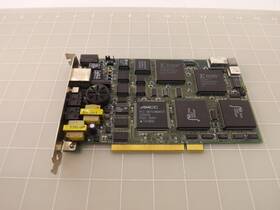
( Brand: Gl Communications ), ( Manufacturer Part Number: T1/E1 ), ( Part Type: Board )
Review GL COMMUNICATIONS T1/e1 Ultra Pci Board
The **GL Communications T1/E1 Ultra PCI Board (Model T44304)** is a high-performance, enterprise-grade network interface card (NIC) designed to deliver robust telecommunication capabilities for data centers, service providers, and mission-critical applications requiring T1/E1 line connectivity. Engineered with precision for reliability and scalability, this PCI-based solution integrates seamlessly into modern server architectures, offering an ideal bridge between traditional telephony networks and high-speed digital infrastructure. Built on advanced ASIC technology, the T44304 supports full-duplex T1/E1 transmission at speeds of up to **1.544 Mbps (T1)** or **2.048 Mbps (E1)**, ensuring efficient data transfer with minimal latency while maintaining strict adherence to ITU-T and ANSI standards. Its compact yet rugged design accommodates standard PCI slots, making it compatible with a wide range of server platforms, from high-end rack-mounted systems to blade servers, without compromising performance.
One of the standout features of the T44304 is its **dual-port configuration**, allowing for redundant or load-balanced connectivity to enhance network resilience and uptime. Each port is equipped with **BERT (Bit Error Rate Test)** functionality, enabling comprehensive diagnostics and troubleshooting for signal integrity, framing errors, and line quality critical for maintaining optimal performance in carrier-grade environments. The board also supports **E1 framing formats**, including G.704, G.732, and G.751, along with **T1 framing options** like ESF (Extended Superframe) and SF (Superframe), ensuring flexibility for diverse network deployments. For enhanced security and data integrity, the T44304 incorporates **CRC (Cyclic Redundancy Check)** and **HDLC (High-Level Data Link Control)** protocols, mitigating packet corruption and ensuring error-free transmission over long-distance links.
Beyond its technical specifications, the T44304 is engineered for **low-latency, high-throughput operations**, making it an excellent choice for applications such as **VoIP gateways, IP telephony, video conferencing, and carrier-grade routing**. Its **PCI 2.2-compliant interface** ensures compatibility with modern operating systems, including Linux (via kernel drivers) and Windows, while its **pluggable RJ-48 connectors** simplify installation and maintenance. The board s **hot-swappable design** further enhances reliability, allowing for seamless upgrades or replacements without disrupting network operations. Additionally, GL Communications has equipped the T44304 with **advanced driver support**, including **kernel bypass (DPDK)** and **SR-IOV (Single Root I/O Virtualization)**, which optimize performance for virtualized environments and high-frequency trading systems.
For organizations requiring **enterprise-grade reliability**, the T44304 includes **fault-tolerant features** such as **auto-negotiation, loopback testing, and signal level monitoring**, ensuring that administrators can proactively address potential issues before they impact service delivery. Its **low power consumption** and **efficient thermal management** make it suitable for dense server deployments, where space and energy efficiency are paramount. Whether deployed in a **data center backbone, ISP infrastructure, or financial trading platform**, the T44304 delivers a balance of **speed, stability, and adaptability**, positioning it as a premium solution for professionals demanding next-level telecommunication performance. With its blend of **hardware robustness and software flexibility**, this PCI board stands as a testament to GL Communications commitment to delivering cutting-edge networking solutions that meet the evolving demands of modern digital communication.
### **Pros and Cons of buying a GL Communications T1/E1 Ultra PCI Board (T44304)**
#### **Pros**
1. **High Performance and Reliability**
The T44304 is a professional-grade T1/E1 PCI card designed for telecom, VoIP, and data transmission applications. It supports full-duplex T1/E1 signaling with low latency, making it suitable for high-speed voice and data services. Its hardware-based processing ensures stable performance even under heavy loads.
2. **Wide Compatibility**
The card is compatible with various operating systems, including Windows (32-bit and 64-bit), Linux (via drivers or kernel modules), and other enterprise-grade environments. It integrates seamlessly with VoIP systems, PBX solutions, and telecom infrastructure, making it versatile for different use cases.
3. **Advanced Features for Telecom Applications**
- Supports **E1 framing formats** (G.703, G.704, G.706) and **T1 framing** (SF, EFM, D4).
- Includes **DSU/CSU functionality**, allowing direct connection to telecom networks without additional hardware.
- Features **loopback testing** and **diagnostic tools** for troubleshooting network issues.
- Offers **V5.2 interface support**, useful for connecting to central office switches.
- Supports **VoIP protocols** (SIP, H.323) and **RTP streaming**, making it ideal for IP telephony deployments.
4. **Scalability and Expansion**
The PCI interface allows for easy integration into existing server or workstation setups. Multiple cards can be installed in a single system for higher channel capacity, though PCI slot availability may be a limiting factor in some cases.
5. **Cost-Effective for High-Channel Applications**
For businesses requiring multiple T1/E1 lines, this card provides a cost-effective alternative to renting dedicated lines from telecom providers. It allows for **channelized T1/E1** (breaking a single line into multiple DS0 channels), which can be useful for multiplexing voice or data traffic.
6. **Enterprise-Grade Build**
The card is designed for rugged use in telecom environments, with proper shielding and cooling considerations. It is built to handle continuous operation without overheating or performance degradation.
7. **Driver and Software Support**
GL Communications provides **comprehensive driver support** for Windows and Linux, along with **APIs and SDKs** for custom application development. This makes integration with existing systems more straightforward.
8. **Useful for Testing and Development**
Engineers and developers working on telecom protocols, VoIP systems, or network emulation can benefit from the card s ability to simulate T1/E1 traffic, test call signaling, and debug network issues.
---
#### **Cons**
1. **PCI Interface Limitations**
- The card uses a **PCI interface**, which may not be available in modern systems (especially those with PCIe-only slots). This could require purchasing a PCI-to-PCIe adapter, adding complexity and potential compatibility issues.
- PCI slots are often shared resources, and installing multiple T1/E1 cards may compete for bandwidth, leading to performance bottlenecks.
2. **Outdated Technology for Some Use Cases**
- While T1/E1 is still used in legacy systems and rural/enterprise networks, many modern applications (especially cloud-based or IP-heavy services) favor **Ethernet-based solutions** (e.g., SFP modules, 10G/40G interfaces).
- For new deployments, alternatives like **VoIP gateways with Ethernet interfaces** or **software-defined networking (SDN) solutions** may be more future-proof.
3. **Limited Channel Density per Slot**
- Each T1/E1 line provides **24 channels (DS0s) for T1** or **32 channels for E1**. While this is sufficient for small to medium deployments, larger setups may require multiple cards, increasing cost and management complexity.
4. **Driver and Configuration Complexity**
- Configuring the card for specific applications (e.g., VoIP, data multiplexing) may require **advanced networking knowledge**. Misconfiguration can lead to dropped calls, latency issues, or network instability.
- Linux support may require manual driver installation or kernel module compilation, which can be challenging for non-technical users.
5. **Physical Space and Power Requirements**
- The card occupies a full-length PCI slot, which may limit options in systems with limited slot availability.
- High-channel utilization can draw significant power, though this is typically not an issue for most server setups.
6. **Depreciation Risk**
- As telecom infrastructure shifts toward **fiber-optic and IP-based solutions**, the demand for T1/E1 hardware may decline. This could affect resale value or long-term availability of spare parts.
7. **No Built-in Redundancy**
- Unlike some enterprise-grade network cards, the T44304 does not natively support **failover or hot-swapping**, meaning a single card failure could disrupt services unless mirrored with another card.
8. **Potential Latency in High-Speed Data Applications**
- While the card is optimized for voice and telecom traffic, **high-speed data applications** (e.g., financial trading, real-time analytics) may still benefit from lower-latency interfaces like **10G Ethernet or InfiniBand**.
---
### **Conclusion**
The **GL Communications T1/E1 Ultra PCI Board (T44304)** is a **highly capable, professional-grade solution** for businesses and enterprises requiring **T1/E1 connectivity for VoIP, telecom, or data multiplexing**. It excels in **reliability, compatibility, and advanced telecom features**, making it ideal for:
- **Legacy telecom systems** requiring T1/E1 integration.
- **VoIP deployments** needing direct analog or digital line access.
- **Network testing and development** environments.
- **Small to medium-scale channelized applications** (e.g., multiplexing voice/data).
However, its **PCI interface limitations, complexity in configuration, and outdated technology for some modern use cases** may make it less suitable for:
- **Cloud-native or IP-heavy deployments** where Ethernet-based solutions dominate.
- **High-density or ultra-low-latency applications** (e.g., financial trading, AI inference).
- **Systems without PCI slots** (common in newer servers).
- **Users without advanced networking expertise** who may struggle with driver setup and troubleshooting.
---
### **Recommendation**
**Buy the T44304 if:**You **require T1/E1 connectivity** for VoIP, PBX, or telecom applications and have a **PCI-compatible system**.
You need **DSU/CSU functionality** or **channelized T1/E1** for multiplexing.
You are working in a **legacy or enterprise telecom environment** where T1/E1 is still the standard.
You have **technical expertise** to configure drivers and troubleshoot network issues.
**Avoid or Consider Alternatives if:**Your system **lacks PCI slots** (consider a **PCIe version** or **USB-based T1/E1 adapters** like those from Digium or Grandstream).
You are deploying a **modern cloud or IP-based telecom solution** (evaluate **VoIP gateways with Ethernet interfaces** or **software-defined telecom platforms**).
You need **higher channel density or lower latency** (explore **10G Ethernet SFP modules** or **FPGA-based telecom cards**).
You lack **networking experience** (simpler VoIP adapters or managed telecom services may be more practical).
**Alternative Options to Consider:**- **PCIe T1/E1 Cards** (e.g., **GL T1/E1 PCIe Card**) If PCI is unavailable, a PCIe version may be a better fit.
- **USB T1/E1 Adapters** (e.g., **Digium T1/E1 USB**) For desktop or low-power applications.
- **VoIP Gateways with Built-in T1/E1** (e.g., **Cisco T1/E1 Gateways, Asterisk-based systems**) For integrated VoIP solutions.
- **Cloud-Based Telephony** (e.g., **AWS Direct Connect, Azure Virtual Network**) For modern, scalable telecom needs.
**Final Verdict:**The **T44304 is a strong choice for traditional telecom deployments** where T1/E1 is non-negotiable, but **modern users should carefully assess whether their needs align with its limitations**. For new projects, evaluating **Ethernet-based or cloud-ready alternatives** may provide better long-term flexibility.
Details:
We proudly sell hard-to-find parts, components, and machines to makers manufacturers. GL COMMUNICATIONS T1/E1 ULTRA PCI BOARD T44304 Brand:: Communications, condition: THIS IS A USED ITEM, IN GOOD CONDITION AND INCLUDES 30 DAY WARRANTY. Glad you stopped by.
part #: t1e1 price
- $250.00
specifications automationjack:
- brand: Gl Communications
- mpn: T1/e1
- part type: Board
seller automationjack:
- rating: 99.7%
- # reviews: 22309
- city: El Paso, Texas
shipping automationjack:
- type: Calculated
- transit: 3-8 Days
- cost: $10.65
- service: UPS Ground, UPS 2nd Day Air, UPS 3 Day Select, UPS Next Day Air
- class: Standard, Expedited, One-day
- carrier: UPS
offer automationjack:
- sold: 0
- availability: In Stock
- quantity: 2
- best offers: True
- started: June 2, 2026
- options: Ship-to-home
returns automationjack:
- method: Money back
- time: 30 Days
- paid by: Seller
- policy: Returns Accepted
general automationjack:
- Business Industrial > Industrial Automation Motion Controls > Other Automation Equipment
- condition: Used
payments automationjack:
- credit card: Discover
- other
- wallet: Apple-pay
Gl Communications T1-E1 Is Similar To:
- Gl Automation 21-3200121-003 2022-2021 Circuit Board Bh0539 (43.8% similar) Gl automation 21-3200121-003 2022 -2021 circuit board BH0539 brand:: automation, condition: this is a used item, in good condition and includes 30 day warranty. Glad you stopped by. Extra information. Open to making bulk deals. Rush orders ship same day. We proudly sell hard-to-find parts, ...(July 21st, 2025)