OMRON S3D-P Sensor Controller Setting Unit
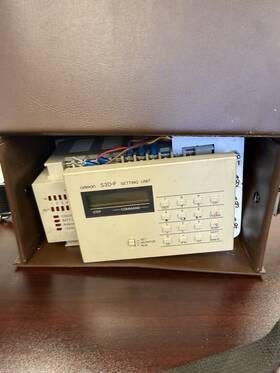
( Brand: Omron ), ( Manufacturer Part Number: S3D-P ), ( Type: Sensor Controller )
Review OMRON Sensor Controller Setting Unit Carrying Case
The **Omron S3D-P S3D Sensor Controller Setting Unit** is a sophisticated, all-in-one device designed to streamline the configuration, calibration, and management of Omron s advanced S3D series proximity and photoelectric sensors. Engineered for industrial automation environments where precision and efficiency are paramount, this compact yet powerful unit serves as a dedicated interface for optimizing sensor performance without the need for direct access to the sensor itself. Its intuitive, user-friendly interface featuring a clear, backlit LCD display and a responsive keypad makes it accessible to both seasoned technicians and operators new to sensor programming, reducing setup time and minimizing human error. The S3D-P is equipped with a robust, IP67-rated enclosure, ensuring durability in harsh manufacturing settings where exposure to dust, moisture, and temperature fluctuations is common. This unit supports a wide range of S3D series sensors, including diffuse, reflective, and through-beam models, allowing for seamless integration into diverse applications such as conveyor monitoring, part detection, level sensing, and position verification. One of its standout features is its ability to store and recall multiple sensor configurations, enabling quick adjustments for different production lines or workflows with just a few keystrokes. The device also includes diagnostic tools that provide real-time feedback on sensor health, signal strength, and operational status, helping to preemptively identify potential issues before they disrupt production. Additionally, the S3D-P offers compatibility with Omron s Sysmac Studio software, facilitating advanced programming, remote monitoring, and integration with larger PLC-based control systems. Whether deployed in a high-speed packaging facility, an automated assembly line, or a precision machining environment, the S3D-P enhances operational reliability by ensuring sensors are always calibrated to their optimal settings, thereby improving accuracy, reducing downtime, and extending equipment lifespan. Its modular design and ease of installation further contribute to its versatility, making it an indispensable asset for industries prioritizing automation efficiency and smart manufacturing.
The **Omron S3D-P** (S3D Sensor Controller Setting Unit) is a device used for programming and configuring Omron proximity sensors, photoelectric sensors, and other industrial I/O devices. Below is a detailed breakdown of its pros and cons, followed by a conclusion and recommendation.
---
### **Pros of buying a Omron S3D-P**
1. **Compatibility with Omron Sensors**
The S3D-P is specifically designed to work with Omron s S3D series sensors, including proximity, photoelectric, and other I/O devices. It ensures seamless integration and configuration without compatibility issues.
2. **User-Friendly Interface**
The device features a clear, intuitive LCD display and simple navigation buttons, making it accessible even for operators with limited technical expertise. The menu-driven setup reduces the learning curve compared to programming via PLCs or PCs.
3. **Offline Configuration**
The S3D-P allows users to program and test sensor settings independently of a PLC or control system. This is useful for troubleshooting, adjusting parameters, or setting up new sensors without disrupting ongoing production.
4. **Quick Parameter Adjustments**
Common sensor functions such as output type (NPN/PNP), sensitivity, response time, and filtering can be adjusted on the fly. This is particularly useful for fine-tuning sensor performance in real-time.
5. **Diagnostic and Testing Capabilities**
The unit provides built-in diagnostics, including sensor self-tests, output verification, and error code display. This helps in quickly identifying and resolving issues without relying on external tools.
6. **Portability and Field Use**
The compact and rugged design makes the S3D-P suitable for field use. Technicians can carry it to the sensor location, configure settings, and verify performance before returning to the control room.
7. **Reduced PLC Load**
By handling sensor-specific configurations locally, the S3D-P reduces the computational load on PLCs, which can improve overall system efficiency and response time.
8. **Cost-Effective for Small to Medium Installations**
For applications where only a few sensors require frequent adjustments, the S3D-P can be a cost-effective alternative to investing in a full-fledged PLC programming software suite.
9. **Omron s Reliability and Support**
Omron is a well-established brand with strong industry support. The S3D-P benefits from Omron s reputation for durability and technical assistance, ensuring long-term reliability.
10. **Future-Proofing with Omron Ecosystem**
The device is part of Omron s broader sensor ecosystem, meaning it can integrate with other Omron products (e.g., PLCs, HMIs) without compatibility issues as your system scales.
---
### **Cons of buying a Omron S3D-P**
1. **Limited to Omron Sensors**
The S3D-P is not compatible with sensors from other manufacturers (e.g., IFM, Sick, Balluff). If your system uses a mix of brands, you may need multiple configuration tools.
2. **Basic Functionality**
The S3D-P lacks advanced features found in PLC programming software, such as complex logic programming, scripting, or integration with SCADA systems. For highly automated or large-scale systems, a PLC may be necessary.
3. **No Remote or Network Configuration**
Unlike modern PLCs or cloud-based tools, the S3D-P does not support remote configuration over Ethernet or wireless networks. Changes must be made physically at the sensor or via direct connection.
4. **Learning Curve for Advanced Users**
While the interface is user-friendly for basic settings, configuring complex sensor functions (e.g., advanced filtering, multi-sensor synchronization) may require familiarity with Omron s documentation or technical support.
5. **Single-User Operation**
The S3D-P is designed for individual use. In collaborative environments where multiple technicians need to configure sensors simultaneously, a centralized system (e.g., PLC or HMI) may be more practical.
6. **No Data Logging or Historical Records**
The device does not store configuration histories or sensor performance data. For applications requiring audit trails or trend analysis, additional tools (e.g., PLCs with logging capabilities) are needed.
7. **Potential for Human Error**
Since configurations are made manually, there is a risk of incorrect settings being entered, especially in high-pressure environments. This can lead to sensor malfunctions or production downtime.
8. **Replacement Costs**
If the S3D-P fails or becomes obsolete, replacing it may require purchasing a new unit, which could be costly compared to software-based solutions that can be updated via licenses.
9. **No Integration with IoT or Digitalization Trends**
The S3D-P is a standalone device and does not support IoT connectivity, predictive maintenance features, or integration with digital twins. For modern Industry 4.0 applications, this is a significant limitation.
10. **Limited Batch Configuration**
While useful for individual sensors, the S3D-P does not support bulk configuration of multiple sensors at once. For large-scale deployments, this can be time-consuming.
---
### **Conclusion**
The **Omron S3D-P** is a practical and efficient tool for configuring Omron sensors in small to medium-sized applications where quick, offline adjustments are needed. Its strengths lie in its simplicity, portability, and compatibility with Omron s ecosystem, making it ideal for maintenance technicians, operators, or small-scale automation setups. However, it is not suitable for complex automation systems, multi-vendor environments, or applications requiring advanced digitalization features.
For users who frequently adjust sensor parameters, troubleshoot issues, or work in field environments, the S3D-P offers significant convenience. Conversely, those managing large-scale PLC-controlled systems, requiring remote configuration, or integrating with non-Omron devices would find it insufficient and may need to rely on PLC programming software or other tools.
---
### **Recommendation**
- **Buy the Omron S3D-P if:**- You exclusively use Omron sensors.
- You need a simple, portable tool for quick sensor adjustments.
- Your application involves small-scale or offline sensor configuration.
- You prioritize ease of use and reduced PLC load.
- Budget constraints make a full PLC programming suite impractical.
- **Avoid the Omron S3D-P if:**- Your system uses sensors from multiple manufacturers.
- You require advanced automation, remote configuration, or IoT integration.
- Your application involves large-scale or complex logic programming.
- You need data logging, historical records, or predictive maintenance features.
- You frequently work in collaborative environments where multiple users need access to configurations.
- **Alternative Solutions:**- For **PLC-based systems**, use Omron s **CX-Programmer** or **Sysmac Studio** for comprehensive configuration.
- For **multi-vendor sensor setups**, consider third-party diagnostic tools or PLCs with universal I/O modules.
- For **digitalization or Industry 4.0 applications**, explore Omron s **Finatech PLCs** or **HMIs** with cloud connectivity.
In summary, the S3D-P is a **niche but valuable tool** for specific use cases, particularly in maintenance and small-scale automation. However, its limitations make it unsuitable for broader or more advanced automation needs.
Details:
Omron S3D Sensor Controller S3D-P Setting Unit with Carrying Case.
part #: s3d prices
- $112.00-$214.50
specifications automationjack:
- brand: Omron
- mpn: S3d-p
- type: Sensor Controller
payments automationjack:
- other
- wallet: Google-pay
- credit card: Visa
returns automationjack:
- policy: No Returns
offer automationjack:
- availability: In Stock
- options: Ship-to-home
- sold: 0
- quantity: 1
- started: February 12, 2026
seller automationjack:
- city: Mount Morris, Michigan
- rating: 100.0%
- # reviews: 367
shipping automationjack:
- cost: $11.16
- transit: 6-12 Days
- carrier: USPS
- class: Expedited
- service: USPS Priority Mail
- type: Calculated
general automationjack:
- Business Industrial > Industrial Automation Motion Controls > Other Automation Equipment
- condition: For parts or not working
Omron S3D Is Similar To:
- Omron C200h-srm21-v1 New Interface Compobus s Master Unit C200hwsrm21v1 (33.8% similar) New Omron C200H-SRM21-V1 interface compo bus/s master unit C200HWSRM21V1...(October 14th, 2023)
- Omron E5en-haa2hhbb E5enhaa2hhbb New Digital Controller Electronic Temperature (36.4% similar) New Omron E5EN-HAA2HHBB E5ENHAA2HHBB digital controller electronic temperature...(November 8th, 2023)
- Omron C200h-lk202-v1 Host Link Unit Module Rs-422 Sysmac C200 Rack Mounting usa (35.9% similar) Some hardware products may contain software and not be legally operated without first purchasing a proper license from the manufacturer of such products. This means that the product arrived as described and in working condition. Our pre-owned items are all either internal re-stock,customer ...(August 4th, 2024)
- Omron Itnc-epx01 Open Network Controller Serial (53.6% similar) Shipping is via our choice of ups ground or USPS priority mail. Are not mentioned, they are included. Only what is pictured included in this listing. The unit is used and has some scuffs scrapes from normal wear. Power supply used to power this unit is not included. If manuals, software, packaging ...(August 22nd, 2024)
- Omron Fz4-600 One Used Controller Operator Panel Tested (43.3% similar) You should receive the item within 2-4 weeks. Please leave a telephone number for on-time delivery. It will just take you 1 minute. Shipping detail. Serious buyers only, please. Return police: the product at fixed price, please pay as soon possible after the purchase...(August 28th, 2024)
- Omron Cj1wv600c12 Cj1w-v600c12 Id Sensor Unit Rifd Radio Head Module Made In Japan (36.7% similar) Free shipping. The module works, and was removed from a working environment. This is an Omron CJ1W-V600C12 id sensor unit riff radio head module made in japan. It is in excellent cosmetic condition...(September 8th, 2024)
- Omron E2e2-x5mb1-m1 Inductive Proximity Sensor 5mm Threaded 271192 (31.8% similar) Manufacturer part number: E2E2-X5MB1-M1. Omron E2E2-X5MB1-M1...(September 17th, 2024)
- Omron Tl-q5mci-c Proximity Switch Sensor (30.5% similar) Omron TL-Q5MCI-C proximity switch sensor warranty information: this is a used item, in good condition and includes 30 day warranty...(October 4th, 2024)
- Omron E8eb-n0c2b Pressure Sensor To 100 Kpa 24 Vdc (36.5% similar) Part #: Omron E8EB-N0C2B for sale...(November 3rd, 2024)
- Smc Ley16dac-150c Linear Slide Actuator With Omron Servo Motor R88m-1m10030t-s2 (18.1% similar) MC linear slide LEY16DAC-150C with Omron servo motor R88M-1M10030T-S2, SMC211...(November 5th, 2024)
- Omron Nx-cif210 Interface Unit Cif210 Rs232c Warranty Fast Shipping (40.9% similar) Removed from running setup. Omron NX-CIF210 interface unit CIF210 RS232C good module...(November 5th, 2024)