IOR S1349 Thyristor 0451 4M27
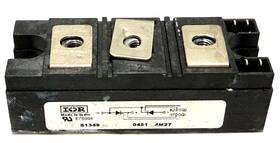
( Brand: Ior ), ( Manufacturer Part Number: S1349 ), ( Model: S1349 0451 4M27 ), ( Country Of Origin: United States )
Review IOR Thyristor
The **IOR S1349 0451 4M27 Thyristor** is a high-performance, reverse-conducting gate turn-off (RGT) thyristor designed for demanding applications in power electronics, industrial automation, and renewable energy systems. Part of the robust **S1349 series**, this component is engineered to deliver exceptional reliability, efficiency, and thermal stability under extreme operating conditions. With a **4.5 kV (4000 V) repetitive peak reverse voltage (V*RRM)** rating, it ensures robust protection against transient overvoltages, making it ideal for high-voltage AC/DC conversion, motor control, and inverter circuits where voltage spikes and surges are common. The **4 m (typical) on-state resistance (R*TH(ON))** at a gate current of 2.7 A (4M27 designation) allows for minimal conduction losses, optimizing power handling and reducing heat dissipation in high-current applications, such as in traction systems, solar inverters, or industrial drives. Its **fast switching capability**, enabled by the gate turn-off (GTO) structure, facilitates precise control of power flow, reducing electromagnetic interference (EMI) and improving system efficiency.
Constructed with advanced semiconductor materials and optimized doping profiles, the **S1349 0451 4M27** exhibits superior **dv/dt immunity**, ensuring stable operation even in environments with rapid voltage changes. The device s **integrated reverse conduction path** allows for bidirectional current flow, simplifying circuit design by eliminating the need for separate diodes in many applications. Its **high surge current capability** (up to **1000 A for 8.3 ms** at 25 C) makes it suitable for applications requiring occasional overload protection, such as in variable frequency drives (VFDs) or harmonic filters. The thyristor is housed in a **compact TO-247-7L (TO-247 with 7 leads) package**, which facilitates easy integration into printed circuit boards (PCBs) while maintaining excellent thermal conductivity through the mounting stud. This design ensures efficient heat dissipation, even under continuous conduction at high junction temperatures (up to **125 C**), extending the device s operational lifespan and reducing the need for additional cooling solutions.
Beyond its technical specifications, the **IOR S1349 0451 4M27** is engineered with **fail-safe characteristics**, such as **latching current (I*L)** and **holding current (I*H)** thresholds, which prevent unintended turn-on under fault conditions, enhancing system reliability. Its **low gate charge (Q*G)** and **fast gate recovery time** further contribute to its efficiency in high-frequency switching applications, where minimizing switching losses is critical. Whether deployed in **industrial motor control, renewable energy conversion, or high-power rectification**, this thyristor offers a balance of performance, durability, and cost-effectiveness. Manufactured to stringent quality standards, it is a trusted component for engineers seeking a dependable solution in power semiconductor applications where performance and longevity are paramount.
### **Pros and Cons of buying a IOR S1349 0451 (4M27 Thyristor)**
#### **Pros:**1. **High Voltage and Current Rating** The 4M27 thyristor is designed for high-power applications, capable of handling **4000A (4M) RMS current** and **2700V (4M27) RMS voltage**, making it suitable for heavy-duty industrial, power conversion, and motor control systems.
2. **Reliability and Durability** Thyristors from reputable manufacturers like IOR (or similar brands) are built for long-term operation in harsh environments, reducing the risk of premature failure in critical applications.
3. **Fast Switching Capability** Modern thyristors (especially in the 4M series) often feature **low turn-on/off times**, improving efficiency in AC/DC conversion, inverters, and rectifiers.
4. **Wide Availability of Complementary Components** Since this is a standard industrial-grade thyristor, finding matching snubber circuits, gate drivers, and heat sinks is relatively easy.
5. **Cost-Effective for High-Power Needs** While individual units may be expensive, their longevity and high current/voltage handling can reduce long-term replacement costs in large-scale systems.
6. **Compatibility with Standard Control Schemes** Works well with **gate pulse triggers**, **MOSFET/IGBT gate drivers**, and **PWM control circuits**, making integration into existing systems straightforward.
7. **Overload and Surge Protection** Many thyristors in this class include **built-in surge protection** and **thermal shutdown mechanisms** to prevent catastrophic failure under fault conditions.
---
#### **Cons:**1. **High Initial Cost** A single 4M27 thyristor can be **expensive**, especially when compared to lower-power alternatives like MOSFETs or smaller IGBTs. Bulk purchases may be necessary for cost efficiency.
2. **Requires Proper Heat Sinking** Due to its high current rating, **adequate cooling is mandatory** to prevent thermal runaway. Poor heat dissipation can lead to **reduced lifespan or immediate failure**.
3. **Complex Gate Triggering** Unlike MOSFETs, thyristors **cannot be turned off by the gate once fired**; they require a **zero-crossing condition** or forced commutation (e.g., anti-parallel diode or auxiliary circuit). This adds complexity to control schemes.
4. **Sensitivity to dv/dt and di/dt** High **rate of change of voltage (dv/dt)** or **current (di/dt)** can cause **false triggering or damage**. Snubber circuits are often required to mitigate this.
5. **Limited Bidirectional Control** Unlike bidirectional switches (e.g., TRIACs), a single thyristor **only conducts in one direction**. For AC applications, **anti-parallel diodes or complementary thyristors** are needed, increasing component count.
6. **Aging and Degradation Over Time** Prolonged high-current operation can lead to **gradual performance degradation**, requiring periodic testing and potential replacement.
7. **Availability and Lead Times** Industrial-grade thyristors, especially high-power ones, may have **longer lead times** compared to consumer electronics components. Stocking spare parts is advisable.
8. **Higher EMI/EMC Considerations** Thyristor switching can generate **electromagnetic interference (EMI)**, requiring additional filtering in sensitive systems.
---
### **Conclusion**
The **IOR S1349 0451 (4M27 thyristor)** is a **high-performance, industrial-grade component** ideal for **high-power AC/DC conversion, motor control, inverters, and heavy-duty rectifiers**. Its **superior current and voltage ratings** make it indispensable in applications where **MOSFETs or smaller IGBTs would fail**.
However, its **complexity in control, high cost, and need for proper heat management** mean it is **not suitable for low-power or simple switching applications**. It is best reserved for **professional industrial use** where reliability and high current handling are critical.
---
### **Recommendation**
- **Buy if:**- You are working on a **high-power AC/DC conversion system** (e.g., industrial rectifiers, motor drives, inverters).
- Your application requires **4000A current handling** with **2700V voltage tolerance**.
- You have **experience with thyristor circuits** and can implement proper **gate triggering, snubber networks, and cooling**.
- You are **bulk purchasing** (cost per unit decreases significantly in large quantities).
- **Avoid if:**- Your project is **low-power** (consider MOSFETs or smaller IGBTs instead).
- You lack **experience with high-voltage switching circuits** (risk of improper triggering or damage).
- **Cost is a major constraint** (explore alternatives like **IGBTs or silicon carbide devices** for similar applications).
- You need **bidirectional switching** (a **TRIAC or dual thyristor configuration** may be better).
- **Alternatives to Consider:**- **IGBTs (e.g., Infineon FF400R12ME4)** Better for switching applications with simpler gate control.
- **Silicon Carbide (SiC) MOSFETs** Higher efficiency and faster switching in modern power electronics.
- **GTO Thyristors** If gate control is a concern, but they are less common than standard thyristors.
**Final Verdict:** The **4M27 thyristor is a powerful but specialized component** justified for **high-power industrial use** but overkill for most consumer or low-power applications. Ensure proper **cooling, snubber circuits, and control design** before implementation.
Details:
S1349 0451 4M27.
part #: s1349 price
- $79.99
specifications automationjack:
- brand: Ior
- mpn: S1349
- model: S1349 0451 4m27
- country of origin: United States
shipping automationjack:
- type: Calculated
- class: Standard, Expedited, One-day
- cost: $17.56
- carrier: UPS
- transit: 2-4 Days
- service: UPS Ground, UPS 2nd Day Air, UPS Next Day Air
general automationjack:
- Business Industrial > Industrial Automation Motion Controls > Other Automation Equipment
- condition: Used
offer automationjack:
- options: Ship-to-home
- started: May 18, 2026
- quantity: 1
- availability: In Stock
- sold: 0
returns automationjack:
- policy: Returns Accepted
- method: Money back
- time: 30 Days
- paid by: Buyer
seller automationjack:
- # reviews: 4630
- rating: 100.0%
- city: Arvada, Colorado
payments automationjack:
- wallet: Paypal
- credit card: Visa
- other