DYNATEM PMC3-0110 Pmc Carrier Board
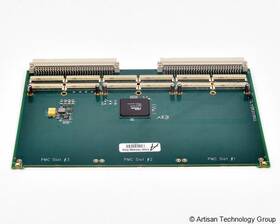
( Brand: Dynatem ), ( Manufacturer Part Number: PMC3-0110 ), ( Part Type: Board ), ( Country Of Origin: United States )
Review DYNATEM Pmc Carrier Board
The **Dynatem PMC3-0110 PMC Carrier Board** is a high-performance, compact PCI Mezzanine Card (PMC) carrier designed to deliver exceptional flexibility and scalability for embedded computing applications requiring robust, high-speed data processing and I/O expansion. Engineered with precision for industrial and aerospace environments, this carrier board supports a wide range of PMC modules, enabling seamless integration into larger backplane systems such as VME, CompactPCI, or other modular architectures. Its robust construction ensures reliable operation in demanding conditions, featuring a rugged aluminum enclosure with precise mounting points to minimize vibration and thermal stress, while also providing excellent heat dissipation through strategically placed heat sinks and thermal vias. The board s compact yet dense layout maximizes space efficiency without compromising performance, making it an ideal choice for applications where size and weight are critical factors, such as defense systems, medical imaging, or real-time signal processing platforms.
At its core, the **PMC3-0110** is built around a high-speed backplane interface that supports data transfer rates up to **640 MB/s** (PCI 2.2 compliant), ensuring compatibility with the latest PMC modules while maintaining backward support for older standards. The carrier board incorporates a **dual-slot PMC connector**, allowing for the installation of either a single PMC module or two smaller, half-height modules, depending on the application requirements. This modularity enhances system adaptability, enabling users to upgrade or reconfigure their hardware without extensive redesign. Additionally, the board features a **PCI-X interface** for seamless integration into existing systems, providing a bridge between the PMC module and the host platform while maintaining full PCI-X compatibility for high-bandwidth applications. For enhanced connectivity, the carrier board includes **optional onboard Ethernet (10/100/1000 Mbps)** and **USB 2.0 ports**, offering versatile I/O options for peripheral connectivity, data logging, or network communication.
The **PMC3-0110** is designed with extensive **configurability and expandability** in mind, offering multiple **user-definable I/O signals** via a **100-pin edge connector**, which can be customized for specialized applications such as digital I/O, analog signals, or high-speed serial interfaces like LVDS or RS-422. This flexibility allows engineers to tailor the board to specific needs, whether for sensor interfacing, control systems, or high-speed data acquisition. To further enhance reliability, the carrier board incorporates **ECC memory support** (when paired with compatible PMC modules), ensuring data integrity in critical applications where errors cannot be tolerated. Additionally, the board includes **watchdog timer functionality**, providing system monitoring and recovery capabilities to prevent crashes in long-running applications.
Thermal management is a key consideration in the design of the **PMC3-0110**, with features such as **active cooling options** (including fan headers for external cooling solutions) and **low-profile heat sinks** to maintain optimal operating temperatures. The board s **wide operating temperature range** (typically **-40 C to 85 C**) makes it suitable for harsh environments, including outdoor deployments, automotive systems, or industrial automation. Power management is also robust, with support for **dual power supply inputs** (e.g., 5V and 12V) and **efficient voltage regulation** to minimize power consumption while ensuring stable operation. The carrier board s **compliance with MIL-STD-883 and other stringent environmental standards** further reinforces its suitability for mission-critical applications where reliability is non-negotiable.
From a software perspective, the **PMC3-0110** is fully compatible with industry-standard **PCIe and PMC drivers**, ensuring seamless integration with major operating systems such as **Linux, VxWorks, QNX, and Windows Embedded**. The board s **pluggable architecture** simplifies development and testing, as PMC modules can be easily swapped without affecting the host system. For developers, the carrier board provides **detailed documentation, including schematics, pinout diagrams, and programming examples**, accelerating the integration process. Whether deployed in **military avionics, medical diagnostics, financial trading systems, or industrial automation**, the **Dynatem PMC3-0110 PMC Carrier Board** delivers a proven, high-performance solution that balances flexibility, reliability, and scalability making it a cornerstone for next-generation embedded computing platforms.
The **Dynatec PMC3-0110 PMC Carrier Board** is a high-performance card designed for PMC (PCI Mezzanine Card) applications, commonly used in rugged computing, industrial automation, and embedded systems. Below is a detailed analysis of its pros and cons, followed by a conclusion and recommendation.
---
### **Pros of the Dynatec PMC3-0110**
1. **High Performance and Speed**
The PMC3-0110 supports high-speed data transfer via PCIe Gen 2 (up to 5 GT/s) and offers robust connectivity options, including Gigabit Ethernet, USB, and serial interfaces. This makes it suitable for applications requiring real-time data processing, such as industrial control, radar processing, or signal acquisition.
2. **Rugged and Reliable Design**
Dynatec s PMC cards are engineered for harsh environments, featuring robust mechanical construction, wide-temperature operation (typically -40 C to 85 C), and resistance to vibration and shock. This makes it ideal for military, aerospace, and industrial applications where reliability is critical.
3. **Flexible I/O Options**
The board includes multiple I/O interfaces such as:- **Gigabit Ethernet** (for networking and data communication)
- **USB 2.0** (for peripheral connectivity)
- **Serial ports (RS-232/422/485)** (for legacy or specialized communication)
- **PCIe x4** (for high-speed data transfer to the host system)
This flexibility allows integration into diverse systems without requiring additional adapters.
4. **Compatibility with PMC Standard**
As a PMC card, it is compatible with a wide range of host systems, including VME, CompactPCI, and other PMC-compatible backplanes. This ensures ease of integration into existing infrastructure.
5. **Support for Advanced Protocols**
The board often includes support for protocols like **TCP/IP, UDP, and Ethernet/IP**, which are essential for industrial automation and networked systems.
6. **Long-Term Availability and Support**
Dynatec is a well-established manufacturer with a history of providing long-term support for its products. This reduces the risk of obsolescence compared to some newer or niche suppliers.
7. **Modularity and Scalability**
The PMC form factor allows for easy expansion and modular design. Multiple PMC cards can be stacked in a single slot, enabling scalable solutions for complex applications.
8. **Low Latency**
For applications requiring real-time processing (e.g., radar, sensor fusion, or control systems), the PMC3-0110 s direct PCIe connection minimizes latency compared to slower bus standards.
---
### **Cons of the Dynatec PMC3-0110**
1. **Cost**
High-performance, rugged PMC cards like the PMC3-0110 are typically more expensive than standard PCIe or USB-based solutions. The cost may be prohibitive for low-budget projects or consumer-grade applications.
2. **Complexity in Integration**
While the PMC standard is robust, integrating a PMC card into a system requires careful consideration of power requirements, cooling, and mechanical constraints. This may necessitate additional design work or custom solutions, increasing development time and cost.
3. **Power Consumption**
The board may draw more power than standard PCIe cards, especially if it includes multiple high-speed interfaces or active components. This requires adequate power supply planning in the host system.
4. **Limited Modern Connectivity**
Unlike newer standards (e.g., PCIe Gen 3/4, Thunderbolt, or USB-C), the PMC3-0110 is based on older but still robust technology. While it supports PCIe Gen 2, this may be a limitation for future-proofing if higher bandwidth is needed.
5. **Dependence on PMC Backplanes**
The PMC form factor requires a compatible backplane or host system. If the target platform does not support PMC, additional adapters or custom solutions may be required, adding complexity.
6. **Size and Form Factor Constraints**
PMC cards are larger than some modern plug-and-play cards (e.g., M.2 or USB 3.0 devices). This may be a limitation in space-constrained applications, such as portable or embedded systems.
7. **Driver and Software Support**
While Dynatec provides documentation and support, some users may encounter challenges with driver compatibility, especially if the host system runs custom or legacy operating systems. Additional development effort may be needed for full functionality.
8. **Limited Consumer Market**
The PMC standard is more common in industrial, military, and aerospace sectors rather than consumer electronics. This can make sourcing spare parts or finding third-party support more difficult compared to mainstream standards.
---
### **Conclusion**
The **Dynatec PMC3-0110 PMC Carrier Board** is an excellent choice for applications requiring **high performance, ruggedness, and flexibility** in environments where reliability is paramount. Its support for **PCIe, Gigabit Ethernet, and serial interfaces**, along with its compatibility with PMC standards, makes it well-suited for industrial automation, military, aerospace, and embedded systems. However, its **higher cost, complexity of integration, and dependence on PMC infrastructure** may not justify its use in cost-sensitive or consumer-grade applications.
If your project demands **real-time data processing, harsh-environment operation, or modular scalability**, the PMC3-0110 is a strong contender. For applications where **lower cost, simplicity, or modern connectivity** (e.g., USB 3.0, PCIe Gen 3 ) are priorities, alternative solutions like **PCIe cards, FPGA modules, or USB-based devices** may be more appropriate.
---
### **Recommendation**
**Buy the Dynatec PMC3-0110 if:**- You are working on an **industrial, military, or aerospace project** requiring rugged and high-performance I/O.
- Your system already uses a **PMC-compatible backplane** (e.g., VME, CompactPCI).
- You need **real-time data acquisition, processing, or control** with low latency.
- Your budget can accommodate the **higher cost** of a specialized, high-reliability solution.
**Avoid the Dynatec PMC3-0110 if:**- Your project is **cost-sensitive** and can use a cheaper, mainstream alternative (e.g., PCIe card, FPGA module).
- Your system lacks a **PMC-compatible host**, requiring additional adapters or custom work.
- You need **modern high-speed interfaces** (e.g., PCIe Gen 3 , Thunderbolt) that the PMC3-0110 does not support.
- Your application is **consumer-grade or low-power**, where simpler solutions would suffice.
For most **industrial, embedded, or high-reliability applications**, the PMC3-0110 is a **solid and well-supported choice**. However, always evaluate whether its features align with your specific requirements before purchasing.
Details:
Are not included with this equipment unless pictured and/or listed in the above. Hours / Location. Fast and hassle-free.
part #: pmc30110 price
- $295.00
specifications automationjack:
- brand: Dynatem
- mpn: Pmc3-0110
- part type: Board
- country of origin: United States
payments automationjack:
- credit card: Mastercard
- other
- wallet: Apple-pay
general automationjack:
- condition: Used
- Business Industrial > Industrial Automation Motion Controls > Other Automation Equipment
shipping automationjack:
- service: FedEx Ground / FedEx Home Delivery, FedEx Standard Overnight, FedEx Ground Economy
- class: Standard, One-day, Economy
- cost: $25.01
- type: Calculated
- transit: 3-7 Days
- carrier: FedEx
returns automationjack:
- policy: Returns Accepted
- time: 30 Days
- method: Money back
- paid by: Buyer
offer automationjack:
- started: April 15, 2026
- options: Ship-to-home
- sold: 0
- quantity: 1
- availability: In Stock
seller automationjack:
- city: Champaign, Illinois
- rating: 99.9%
- # reviews: 17706