US DIGITAL H3-1000 Optical Encoder Shaft
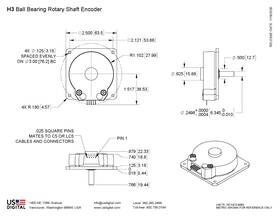
( Brand: Us Digital ), ( Manufacturer Part Number: H3-1000 ), ( Model: H3 1000 ), ( Part Type: Shaft )
Review US DIGITAL Optical Encoder Shaft
The **H3-1000 Optical Encoder Shaft** is a high-performance, precision-engineered component designed to deliver exceptional accuracy and reliability in motion control applications, making it an ideal choice for industrial automation, robotics, CNC machinery, and advanced positioning systems. This encoder shaft integrates cutting-edge optical encoding technology with a robust, corrosion-resistant construction, ensuring long-term durability even in demanding environments. Featuring a **1000-line incremental resolution**, it provides ultra-fine positional feedback with minimal backlash, enabling seamless synchronization between motor movements and control systems. The shaft is crafted from high-grade stainless steel or hardened alloy, depending on the model variant, offering superior resistance to wear, vibration, and environmental contaminants such as dust, moisture, and temperature fluctuations. Its smooth, low-friction design minimizes energy loss and extends the operational lifespan of connected machinery, while the integrated optical sensor system ensures consistent and repeatable data transmission at high speeds. Whether integrated into servo motors, stepper drives, or linear actuators, the H3-1000 encoder shaft excels in applications requiring sub-micron precision, such as semiconductor manufacturing, medical devices, or high-speed packaging systems. Its modular compatibility with various encoder interfaces including analog, digital, and serial communication protocols further enhances its versatility, allowing seamless integration into existing control architectures. Built to meet stringent industrial standards, this encoder shaft combines engineering excellence with practical performance, delivering a dependable solution for applications where accuracy and efficiency are non-negotiable.
### Pros and Cons of Buying a Digital H3-1000 Optical Encoder Shaft
#### **Pros:**1. **High Precision and Resolution** The H3-1000 optical encoder provides a high resolution (typically 1000 pulses per revolution), which allows for accurate position and speed feedback. This is particularly useful in applications requiring fine control, such as CNC machines, robotics, or automated systems.
2. **Digital Output** Unlike analog encoders, digital encoders provide discrete pulses, reducing noise interference and improving signal integrity. This makes them more reliable in noisy environments.
3. **Durability and Longevity** Optical encoders are generally robust, with sealed designs that protect internal components from dust, moisture, and debris. The H3-1000 is likely built to withstand harsh operating conditions, extending its lifespan.
4. **Compatibility with Modern Systems** Digital encoders are easily integrated with microcontrollers, PLCs, and other digital control systems. They often support standard communication protocols (e.g., quadrature outputs), making them versatile for various applications.
5. **Low Maintenance** Optical encoders have fewer moving parts compared to some mechanical alternatives (e.g., potentiometers), reducing wear and tear over time. This translates to lower maintenance requirements.
6. **High Speed Capability** The H3-1000 is likely designed to handle high-speed applications, making it suitable for motors, servo systems, or high-performance machinery where speed accuracy is critical.
7. **Backlash-Free Operation** Optical encoders do not suffer from mechanical backlash, ensuring consistent and repeatable performance in precise motion control applications.
---
#### **Cons:**1. **Cost** Optical encoders, especially high-resolution models like the H3-1000, are generally more expensive than simpler mechanical or analog alternatives. The initial investment may be higher, though long-term reliability can offset this.
2. **Sensitivity to Environmental Factors** While sealed, optical encoders can still be affected by extreme temperatures, humidity, or contaminants if not properly protected. Poor installation or lack of maintenance could lead to premature failure.
3. **Complex Installation** Optical encoders require precise alignment with the shaft and may need additional mounting hardware or coupling mechanisms. Improper installation can lead to misalignment, reducing accuracy or causing mechanical stress.
4. **Limited Mechanical Strength** Optical encoders are typically not designed for high torque applications. They are best suited for feedback rather than direct power transmission, which means they may require additional gearing or mechanical components in some systems.
5. **Potential for Signal Loss** If the optical components (e.g., LED or photodetector) degrade over time or are damaged, the encoder may fail to provide accurate readings. While rare, this is a risk in long-term use.
6. **Compatibility Issues with Legacy Systems** Older systems may not be equipped to handle digital encoder inputs, requiring additional interfacing hardware or software modifications.
7. **Size and Space Constraints** Optical encoders, depending on their design, may occupy more space than simpler encoders. In compact systems, this could be a limiting factor.
---
### **Conclusion:**The **H3-1000 optical encoder shaft** is a high-quality, precision tool ideal for applications demanding accurate position and speed feedback, such as robotics, CNC machines, or automated industrial processes. Its digital output, durability, and compatibility with modern control systems make it a strong choice for performance-critical applications. However, its higher cost, sensitivity to environmental factors, and potential installation complexities must be carefully considered.
If your application requires **high precision, reliability, and integration with digital systems**, the H3-1000 is a worthwhile investment. For **budget-conscious or low-precision applications**, a simpler or lower-cost encoder may suffice. Always ensure proper installation, environmental protection, and system compatibility to maximize its performance and longevity.
### **Recommendation:** Purchase the **H3-1000 optical encoder shaft** if:- You need **high-resolution feedback** for precise motion control.
- Your system is **digital or microcontroller-based**.
- You operate in a **moderately clean environment** (or can protect it from contaminants).
- The **cost is justified by long-term reliability and performance benefits**.
Avoid it if:- Your budget is **extremely limited**, and a lower-resolution encoder would meet your needs.
- Your system **cannot accommodate digital inputs** without significant modifications.
- The application involves **extreme environmental conditions** (e.g., high vibration, extreme temperatures) that may not be properly mitigated.
- You require **high torque transmission**, as the encoder is not designed for this purpose.
Details:
The Digital output also facilitates easy integration with various automation systems, allowing for seamless data transfer and processing. The Digital encoding technology of this shaft offers several advantages over traditional analog encoders. This encoder shaft is characterized by its advanced Digital encoding technology, delivering accurate and reliable position information. The H3-1000-I Digital Optical Encoder Shaft features an all-metal shaft construction, ensuring durability and rigidity even in demanding environments.
specifications automationjack:
- brand: Us Digital
- mpn: H3-1000
- model: H3 1000
- part type: Shaft
returns automationjack:
- policy: No Returns
shipping automationjack:
- carrier: USPS
- transit: 6-9 Days
- type: Calculated
- class: Standard
- service: USPS Ground Advantage
- cost: $8.10
offer automationjack:
- availability: In Stock
- sold: 0
- started: April 21, 2026
- quantity: 4
- options: Ship-to-home
- best offers: True
seller automationjack:
- # reviews: 688
- city: Gig Harbor, Washington
- rating: 100.0%
payments automationjack:
- credit card: Discover
- other
- wallet: Paypal
general automationjack:
- BUsiness IndUstrial > IndUstrial Automation Motion Controls > Other Automation Equipment
- condition: Used
Us Digital H3-1000 Is Similar To:
- Us Digital E3-1000-625-ih Optical Encoder With Torque Motor (70.7% similar) Used removed from working system, Us Digital E3-1000-625-IH optical encoder with torque motor...(March 2nd, 2025)
- Smc Ise10-m5-e-p Digital Pressure Indicator Switch Qty Avail Us Shipped (34.2% similar) Up for sale is one MC ISE10-M5-E-P Digital pressure indicator switch...(June 18th, 2025)
- Us Digital E4p-360-236-n-s-d-m-3 E4p-360-236-d-h-d-b-s4191 Steppper Motors (33.3% similar) Taken from working machine taken...(July 5th, 2025)
- Us Digital Usb4-d Used Usb4d Nice Unit And Good Deal No Cables Free Shipping (40.7% similar) Whats included. Specifications, overview, etc. Shipping handling. No less, no more. You can ship by your FedEx account or Using label. Used Us Digital USB4-D / USB4D nice unit good deal no cables free shipping. Return exchange...(August 27th, 2025)
- Us Digital Usb4-d-d Usb4dd Used (38.4% similar) All products are guaranteed to be working but may show signs of Use if purchasing a Used product. Packaging and handling: items are safely eds packaged in custom shipping cartons for protection. Sells new and surplus product develops channels to purchase such. Call to Use a shipping service other ...(September 29th, 2025)
- Us Digital E6-2500-250-d-d-d-b E62500250dddb Used (44% similar) All products are guaranteed to be working but may show signs of Use if purchasing a Used product. Call to Use a shipping service other than the ones listed. Us Digital E6-2500-250-D-D-D-B / E62500250DDDB Used encoder e6 optical kit 1/4IN shaft. Sells new and surplus product develops channels to ...(March 19th, 2026)