PIONEERPOS EBC-GF42 Caristouch Motherboard A1 19A7GF4203-01
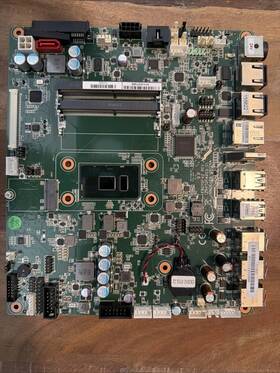
( Brand: Pioneerpos ), ( Manufacturer Part Number: EBC-GF42 ), ( Type: Motherboard ), ( Unit Type: Unit ), ( Country Of Manufacture: China )
Review PIONEERPOS Rev A1 Caristouch Motherboard
The **Pioneer POS EBC-GF42-A1 Caristouch Motherboard (Model: 19A7GF4203-01)** is a high-performance, industrial-grade embedded motherboard designed specifically for rugged point-of-sale (POS) and commercial kiosk applications where reliability, efficiency, and flexibility are paramount. Built on a compact yet robust form factor, this motherboard integrates a powerful **Intel Celeron N5105 (Jasper Lake) processor**, delivering a balanced blend of performance and energy efficiency for demanding tasks such as inventory management, digital signage, and transaction processing. The N5105, clocked at up to **2.0 GHz with dual cores and four threads**, ensures smooth multitasking while maintaining low power consumption, making it ideal for 24/7 operation in retail, hospitality, or self-service environments.
At its core, the **EBC-GF42-A1** is engineered for durability, featuring a **fanless design** that eliminates noise and reduces maintenance while dissipating heat efficiently through passive cooling. This makes it perfectly suited for environments where silent operation and minimal upkeep are critical, such as in-store terminals, gas stations, or outdoor kiosks exposed to varying temperatures. The motherboard supports **up to 32GB of DDR4 SODIMM memory** (2 slots, unbuffered, ECC optional), providing ample headroom for running multiple applications, large databases, or high-resolution displays without sacrificing performance. Additionally, it incorporates **Intel UHD Graphics**, enabling seamless integration with **4K displays** or multiple monitors for enhanced user interfaces, making it a versatile choice for modern POS systems requiring rich graphical interfaces.
For connectivity, the **EBC-GF42-A1** delivers a comprehensive suite of ports and interfaces tailored for professional use. It includes **two USB 3.2 Gen 1 (Type-A) ports**, **two USB 2.0 ports**, and **one HDMI 2.0 port** for high-definition video output, ensuring compatibility with modern peripherals and touchscreen displays. Networking is handled via **Intel I219-LM Gigabit Ethernet**, providing stable and high-speed connectivity for POS systems requiring real-time transactions, cloud integration, or remote management. Security is also a priority, with built-in **TPM 2.0 support** for hardware-based encryption, protecting sensitive customer data and financial transactions. The motherboard further supports **PCIe x16 (Gen 3) and M.2 (Key M) slots**, allowing for expandability with additional storage, wireless modules, or specialized cards like barcode scanners or RFID readers.
The **Caristouch** series emphasizes ease of integration and deployment, with the **EBC-GF42-A1** featuring **Pioneer s Caristouch OS support**, a lightweight, pre-configured operating system optimized for POS applications. This simplifies setup and reduces development time, enabling businesses to deploy kiosks or terminals quickly without extensive IT overhead. The motherboard also adheres to strict **industrial standards**, including **wide operating temperature ranges (-20 C to 60 C)**, **vibration resistance**, and **IP40-rated connectivity**, ensuring reliability in harsh or fluctuating environments. Whether deployed in a high-traffic retail store, a fast-food drive-thru, or a government service center, this motherboard delivers the robustness and performance needed to handle continuous operation with minimal downtime.
For businesses prioritizing **cost efficiency and longevity**, the **EBC-GF42-A1** offers a compelling alternative to traditional desktop systems, combining the power of a modern embedded platform with the reliability of Pioneer s industrial-grade components. Its **low-power design** reduces operational costs, while its **modular expandability** ensures adaptability to future upgrades. Whether used as the backbone of a custom POS terminal, a digital menu board, or an interactive self-service station, this motherboard exemplifies Pioneer s commitment to delivering high-performance, future-proof solutions for commercial and industrial applications.
The **Pioneer POS EBC-GF42 A1 Caristouch Motherboard (19A7GF4203-01)** is a popular choice for building or upgrading a POS (Point of Sale) system, particularly for Android-based kiosks, digital signage, or retail terminals. Below is a detailed breakdown of its pros and cons, followed by a conclusion and recommendation.
---
### **Pros**
1. **Android-Based Flexibility**
The motherboard runs on Android (typically Android 5.1 Lollipop or similar), which allows for easy customization with various POS software, digital signage apps, or browser-based solutions. This makes it versatile for different use cases beyond traditional POS functions.
2. **Compact and Space-Efficient Design**
The form factor is small (typically 19.5" x 13.5" or similar), making it ideal for installations where space is limited, such as behind retail counters, in kiosks, or in tight cabinetry.
3. **Touchscreen Integration**
The "Caristouch" designation indicates it is designed to work seamlessly with capacitive touchscreens (often 10.1" or 15" displays). This simplifies setup, as the motherboard handles touch input calibration and driver management, reducing the need for additional hardware.
4. **Reliability and Durability**
Pioneer POS systems are known for their robustness in retail environments. The motherboard is built to handle continuous use, with components that are less prone to overheating or failure compared to consumer-grade devices.
5. **Pre-Installed Android with POS Optimizations**
The motherboard often comes with a pre-loaded Android image optimized for POS tasks, including features like:- Fast boot times.
- Support for payment terminals (via USB or serial ports).
- Compatibility with common POS software (e.g., Square, Toast, Lightspeed).
This reduces the need for extensive setup or troubleshooting.
6. **Multiple Connectivity Options**
The motherboard typically includes:- USB ports (for peripherals like scanners, printers, or payment devices).
- Ethernet (for network connectivity and updates).
- Serial/COM ports (for legacy hardware like cash drawers or receipt printers).
- HDMI or VGA output (for display).
This makes it easy to integrate with existing hardware.
7. **Low Power Consumption**
Compared to desktop PCs, this motherboard consumes minimal power (often under 20W), making it energy-efficient for 24/7 operation.
8. **Long-Term Availability**
Pioneer POS components are widely used in retail, so finding replacement parts or support is easier than with niche or discontinued hardware.
9. **No Fan Required (Passive Cooling)**
Many models use passive cooling, reducing noise and maintenance needs. This is ideal for quiet environments like stores or cafes.
10. **Support for Custom Android Builds**
For advanced users, the Android system can be rooted or modified to run custom apps, extend the lifespan of the device, or add features not natively supported.
---
### **Cons**
1. **Outdated Software**
The motherboard typically runs an older version of Android (e.g., 5.1 or 6.0), which lacks modern security updates, app compatibility, or performance optimizations. This can be a limitation if you need to run newer POS software or apps that require Android 8.0 or higher.
2. **Limited Upgrade Path**
Unlike a traditional PC, you cannot easily upgrade the motherboard s hardware (e.g., RAM or storage). The onboard storage is often limited (e.g., 8GB eMMC), and while some models support microSD cards, this is not a reliable long-term solution.
3. **Vendor Lock-In**
Pioneer POS systems are proprietary in nature. If you encounter issues, support may require purchasing from Pioneer or authorized resellers, which can be costly. Customization is also limited compared to open-source alternatives like Raspberry Pi or Intel NUCs.
4. **No Support for Modern GPUs or High-End Graphics**
The onboard graphics are basic, so running graphics-intensive apps (e.g., video editing, complex dashboards) is not feasible. This is not usually an issue for POS systems, but it s a limitation to note.
5. **Limited Expansion**
There are few expansion slots or ports for adding peripherals beyond the basics. If you need additional USB ports, serial ports, or other interfaces, you may need a USB hub or adapter, which can introduce compatibility issues.
6. **Potential for Bloatware**
Some pre-loaded Android images include unnecessary apps or services that consume resources. These may not be removable without rooting the device.
7. **Dependence on Pioneer s Ecosystem**
If you re using Pioneer s proprietary software or drivers, switching to a different POS system or hardware may require a full reconfiguration. This can be disruptive if you later decide to change vendors.
8. **No Support for Modern Security Features**
Older Android versions lack features like Android s built-in security patches, biometric authentication, or modern encryption protocols. This could be a concern if the device handles sensitive customer data.
9. **Limited Community or Third-Party Support**
Unlike popular platforms like Raspberry Pi or Ubuntu-based systems, there is little community support or third-party documentation for troubleshooting or customization.
10. **Potential for Obsolescence**
As retail technology evolves (e.g., cloud-based POS, mobile-first solutions), older hardware like this may become less relevant. Investing in a more future-proof solution might be wise for long-term projects.
---
### **Conclusion**
The **Pioneer POS EBC-GF42 A1 Caristouch Motherboard** is an excellent choice for **budget-friendly, low-maintenance POS systems** where reliability and simplicity are prioritized over cutting-edge features. It excels in environments where:
- You need a **plug-and-play** solution with minimal setup.
- The device will run **basic POS tasks** (e.g., payments, inventory, receipt printing).
- **Space is limited**, and a compact form factor is required.
- You want **long-term reliability** without frequent upgrades.
However, if you require:- **Modern Android features** (e.g., newer apps, security updates).
- **Customization or future-proofing** (e.g., ability to upgrade software or hardware).
- **High-end graphics or advanced peripherals**.
- **Open-source or community-supported alternatives**.
...then this motherboard may not be the best long-term investment. In such cases, alternatives like **Intel NUCs, Raspberry Pi (with custom Android builds), or cloud-based POS solutions** might be more suitable.
---
### **Recommendation**
**Buy the Pioneer EBC-GF42 A1 if:**- You are building a **simple, low-cost POS terminal** for a retail store, caf , or small business.
- You need **touchscreen compatibility** with minimal calibration hassles.
- You prefer **proprietary support** and don t mind the limitations of older Android.
- Your use case does not require **modern software or high-end performance**.
**Avoid or Consider Alternatives if:**- You anticipate needing **long-term software updates** or **modern app support**.
- You want **flexibility to upgrade or customize** the system.
- You are working with **sensitive data** and need **stronger security features**.
- You are open to **more powerful but slightly more complex** solutions (e.g., Intel-based mini PCs).
**Alternatives to Explore:**1. **Intel NUC (e.g., NUC 11/12 Series)** More powerful, supports modern Android (via custom builds) or Windows, and has better upgrade paths.
2. **Raspberry Pi 4/5 Custom Android** Cheaper, highly customizable, but requires more technical setup.
3. **Cloud-Based POS (e.g., Square, Lightspeed, Toast)** Eliminates hardware concerns entirely, with updates handled by the provider.
4. **Other POS-Specific Hardware (e.g., Panasonic Toughbook, Dell Latitude)** More robust for rugged environments but often more expensive.
For most **small to medium-sized retail businesses** running basic POS functions, the Pioneer motherboard remains a **cost-effective and reliable choice**. However, weigh the trade-offs carefully based on your specific needs and future growth plans.
Details:
specifications automationjack:
- brand: Pioneerpos
- mpn: Ebc-gf42
- type: Motherboard
- unit type: Unit
- country of manufacture: China
payments automationjack:
- credit card: Mastercard
- wallet: Paypal
- other
seller automationjack:
- # reviews: 19
- rating: 100.0%
- city: Ladera Ranch, California
returns automationjack:
- policy: No Returns
offer automationjack:
- started: April 22, 2026
- sold: 0
- quantity: 1
- availability: In Stock
- options: Ship-to-home
- best offers: True
general automationjack:
- Business Industrial > Industrial Automation Motion Controls > Other Automation Equipment
- condition: Used
shipping automationjack:
- transit: 5-10 Days
- carrier: USPS
- cost: $11.23
- type: Calculated
- service: USPS Ground Advantage
- class: Standard