TEXAS INSTRUMENTS CC1200EMK-868-930 Evaluation Module 2PC
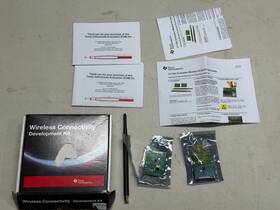
( Brand: Texas Instruments ), ( Manufacturer Part Number: CC1200EMK-868-930 ), ( Part Type: Module )
Review TEXAS INSTRUMENTS 2pc New Evaluation Module Kits
The **Texas Instruments CC1200EMK-868-930 2-Piece Evaluation Module** is a sophisticated, high-performance wireless development kit designed for engineers and developers seeking to harness the power of Sub-GHz radio frequency (RF) communication in their IoT, industrial automation, or remote sensing applications. This evaluation module consists of two key components: the **CC1200EMK** baseboard and a **CC1200EMK-868-930** RF transceiver module, which operates in the globally accessible **868 MHz (Europe) and 915 MHz (Americas) ISM bands**, as well as the **930 MHz band** (commonly used in Asia and other regions). Built around TI s **CC1200 Sub-GHz transceiver**, this module delivers exceptional range, low power consumption, and robust modulation schemes including **GFSK, OOK, and ASK** making it ideal for long-range, low-data-rate wireless applications where energy efficiency and reliability are critical.
The **CC1200EMK-868-930** itself is a compact, fully integrated RF module that combines a **highly sensitive receiver**, a **powerful transmitter**, and a **low-power microcontroller interface** into a single, easy-to-use package. Its **868/915/930 MHz frequency flexibility** allows developers to deploy solutions across multiple global regulatory domains without hardware modifications, while its **adjustable output power (up to 10 dBm)** ensures optimal performance in both short-range and extended-range scenarios. The module s **integrated antenna** simplifies PCB design, reducing development time and cost, while its **FSK/GFSK modulation support** enables seamless integration with existing wireless protocols like **LoRaWAN, Zigbee, or proprietary RF systems**. Additionally, the **CC1200 s advanced RF front-end** includes features such as **RSSI (Received Signal Strength Indicator), link budget optimization, and adaptive frequency hopping**, enhancing robustness in challenging environments with interference or multipath fading.
The accompanying **CC1200EMK baseboard** serves as a versatile development platform, featuring a **TI MSP430 microcontroller** for firmware development, a **USB interface** for easy programming and debugging, and a **rich set of peripherals** including LEDs, buttons, and analog/digital I/O pins. This modular design allows engineers to prototype and test wireless communication systems quickly, with the ability to expand functionality through additional sensors, actuators, or custom circuitry. The **MSP430 s ultra-low power consumption** complements the CC1200 s efficiency, making this evaluation module particularly well-suited for battery-powered applications where energy harvesting or extended operational lifetimes are essential. Whether deploying a **smart metering solution, a wireless sensor network, or an industrial asset tracker**, the CC1200EMK-868-930 provides the flexibility and performance needed to build scalable, long-range wireless systems with minimal development overhead.
Beyond its technical capabilities, the **CC1200EMK-868-930** is designed with developer convenience in mind. Texas Instruments provides **comprehensive documentation**, including **reference manuals, API libraries, and example code**, to accelerate development. The module s **open architecture** allows for easy integration with third-party tools like **IAR Embedded Workbench, Code Composer Studio, or TI s free **SimpleLink software**, ensuring compatibility with a wide range of development environments. For those exploring **LoRaWAN or proprietary RF protocols**, the module s **configurable data rates and packet structures** enable fine-tuned optimization for specific use cases, whether prioritizing **low latency, high throughput, or maximum range**. With its **industrial-grade reliability, global frequency support, and seamless integration with TI s ecosystem of sensors and microcontrollers**, the **CC1200EMK-868-930** stands as a powerful yet accessible tool for pushing the boundaries of wireless innovation.
### **Pros and Cons of buying a Texas Instruments CC1200EMK-868-930 (2-Piece Evaluation Module)**
#### **Pros**
1. **Sub-GHz Wireless Capability** The CC1200 supports frequencies in the 868 MHz and 915 MHz bands, making it suitable for long-range, low-power wireless applications in Europe and North America. This is ideal for IoT, remote sensing, and industrial automation where wide-area coverage is needed.
2. **Low Power Consumption** The module is designed for energy-efficient operation, which is critical for battery-powered devices. This extends the lifespan of devices in remote or hard-to-reach locations, reducing maintenance costs.
3. **Flexible and Programmable** The CC1200 is based on the CC1100/CC1200 family, which offers configurable data rates, modulation schemes (e.g., OOK, ASK, FSK, GFSK), and spread spectrum techniques. This flexibility allows developers to optimize performance for specific use cases, such as low latency or high reliability.
4. **Development-Friendly** The evaluation module comes with pre-loaded firmware and documentation, including example code and a user guide. This accelerates prototyping and reduces the learning curve for developers unfamiliar with Sub-GHz wireless protocols.
5. **Compatibility with TI s Ecosystem** The module integrates well with Texas Instruments other tools and platforms, such as the SimpleLink WiLink, CC2530, and MSP430 microcontrollers. This makes it easier to build end-to-end wireless solutions without switching between disparate hardware or software stacks.
6. **Cost-Effective for Prototyping** While not the cheapest option, the evaluation module provides a balanced cost for testing and validating designs before committing to mass production. The two-piece kit (transmitter and receiver) allows for immediate hands-on experimentation.
7. **Reliable Performance in Challenging Environments** The CC1200 is designed to operate in harsh conditions, including temperature variations and interference-prone environments. This makes it suitable for outdoor applications, agricultural monitoring, or industrial settings where robustness is essential.
8. **Open Development Resources** Texas Instruments provides extensive documentation, software libraries, and community support. This ensures that developers can troubleshoot issues and access updates without relying solely on third-party resources.
---
#### **Cons**
1. **Limited to Sub-GHz Bands** The module does not support higher-frequency bands (e.g., 2.4 GHz), which are used in Wi-Fi, Bluetooth, or Zigbee. If your application requires multi-band flexibility, you may need additional hardware.
2. **No Built-In Antenna Options** The evaluation module typically includes a PCB trace antenna, which may not provide optimal range in all environments. For long-range applications, you may need to purchase and integrate an external antenna, adding complexity and cost.
3. **Learning Curve for Advanced Features** While the module is user-friendly for basic applications, configuring advanced features like spread spectrum or adaptive frequency hopping requires a deeper understanding of wireless protocols. Developers unfamiliar with RF engineering may struggle with optimization.
4. **No Built-In Security Features** Unlike some other wireless modules (e.g., LoRa-based devices), the CC1200 does not include built-in encryption or authentication. Security must be implemented at the application layer, which adds complexity for sensitive use cases.
5. **Deprecation Risk** Texas Instruments occasionally phases out older products in favor of newer, more efficient alternatives (e.g., the CC13xx/CC26xx series). While the CC1200 is still supported, future compatibility or toolchain updates may become limited.
6. **Limited Commercial Availability** The evaluation module is not a production-ready part. For mass manufacturing, you would need to source the CC1200 chip separately and design your own PCB, which increases development time and cost.
7. **No Built-In Debugging Tools** Unlike some microcontroller-based modules, the CC1200 lacks integrated debug interfaces (e.g., JTAG or SWD) for real-time monitoring. Debugging may require external tools or additional hardware.
8. **Potential Interference Issues** Sub-GHz frequencies can be susceptible to interference from other wireless devices (e.g., RFID systems, industrial motors). Testing and tuning may be required to ensure reliable communication in mixed environments.
---
### **Conclusion**
The **Texas Instruments CC1200EMK-868-930 evaluation module** is a strong choice for developers and engineers working on **low-power, long-range wireless applications** in the Sub-GHz bands. Its flexibility, low power consumption, and compatibility with TI s ecosystem make it ideal for prototyping IoT devices, remote sensors, or industrial wireless networks. However, its limitations such as lack of built-in security, no 2.4 GHz support, and the need for external antennas may require additional work depending on the specific application.
If your project **prioritizes long-range, low-power communication in Sub-GHz bands** and you are willing to invest time in testing and optimization, this module is a **solid investment for development**. For applications requiring **higher frequencies, built-in security, or mass production readiness**, you may need to supplement it with additional hardware or consider alternative solutions like LoRa or Zigbee modules.
### **Recommendation**
- **Buy the CC1200EMK-868-930 if:**- You need a **Sub-GHz wireless solution** for low-power, long-range applications (e.g., smart agriculture, industrial monitoring, or remote metering).
- You are working within a **TI-based development ecosystem** and want to leverage existing tools and libraries.
- You are in the **prototyping phase** and can handle the learning curve for RF configuration.
- **Consider alternatives if:**- Your application requires **2.4 GHz or higher frequency bands** (e.g., Wi-Fi, Bluetooth, or Zigbee).
- You need **built-in security features** (e.g., encryption, authentication).
- You are targeting **mass production** and need a more streamlined, production-ready module.
- You require **simpler integration** with non-TI hardware or platforms.
For most **Sub-GHz-focused IoT or wireless sensor projects**, the CC1200EMK is a **highly capable evaluation tool** that will save time and reduce risk during development. Pair it with proper testing and antenna selection to maximize performance.
Details:
This is for 2x CC1200EMK-868-930, one sealed, opened. Includes 1 antenna and various manuals.
part #: cc1200emk868930 price
- $99.99
specifications automationjack:
- brand: Texas Instruments
- mpn: Cc1200emk-868-930
- part type: Module
shipping automationjack:
- transit: 7-13 Days
- service: Economy
- class: Economy
- type: Fixed
- cost: $0.00
offer automationjack:
- started: May 27, 2026
- sold: 0
- quantity: 1
- best offers: True
- options: Ship-to-home
- availability: In Stock
seller automationjack:
- city: Gladwin, Michigan
- rating: 100.0%
- # reviews: 1731
returns automationjack:
- policy: No Returns
general automationjack:
- condition: Used
- Business Industrial > Industrial Automation Motion Controls > Other Automation Equipment
payments automationjack:
- credit card: Visa
- other
- wallet: Apple-pay
Texas Instruments CC1200EMK-868-930 Is Similar To:
- Texas Instruments J721excp01evm Jacinto 7 Automotive Processor Eval Board Vision (40.8% similar) In order to give you the lowest possible rate, we combine shipping charges on multiple orders...(December 11th, 2024)
- Texas Instruments 520-1101 Controller Module 110 220v 300va Used (50% similar) Shipped with ups ground. Condition is used...(May 7th, 2025)
- Texas Instruments 565-2120 Siemens Cpu Module Used (55.7% similar) Condition is used. Shipped with ups ground...(June 4th, 2025)
- Xyz 500-5186 Texas Instruments Siemens Esp Expert Solutions Processor 5005186 Used (39% similar) Shipped with ups ground. Condition is used...(August 16th, 2025)
- Texas Instruments 500-5026 Rapid Response Module 24vdc Item 303 (56.9% similar) ...(August 27th, 2025)
- Texas Instruments 560-2820 Siemens Cpu Module Repaired (52.4% similar) Condition is used. Shipped with ups ground...(December 18th, 2025)
- Texas Instruments Semi 51aa1b1a1 Used (43.2% similar) Part number 51AA1B1A1. All products are guaranteed to be working but may show signs of use if purchasing a used product. Sells new and surplus product develops channels to purchase such. Packaging and handling: items are safely eds packaged in custom shipping cartons for protection. Call to use a ...(February 9th, 2026)