GALIL CB-1500 Optima Converter Board
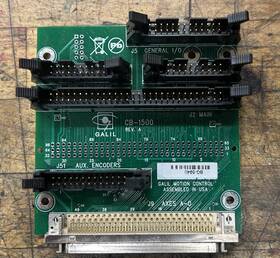
( Brand: Galil ), ( Manufacturer Part Number: CB-1500 ), ( Part Type: Converter Board )
Review GALIL Legacy to optima Converter Board Lot Of
The **Galil CB-1500 Legacy-to-Optima Converter Board** is a precision-engineered interface module designed to bridge the gap between Galil s legacy **DMC-1500** motion controller series and modern **Optima** controllers, enabling seamless integration into advanced CNC, robotics, or automated systems. This high-performance converter board serves as a critical intermediary, translating the legacy **DMC-1500 s** proprietary communication protocols such as **RS-232, RS-422, or parallel interfaces** into the optimized, high-speed **Optima-compatible** signals required for next-generation motion control applications. Built with robust **16-bit analog-to-digital (A/D) and digital-to-analog (D/A) converters**, the board ensures accurate position, velocity, and torque feedback while maintaining minimal latency, making it ideal for high-precision applications like **multi-axis CNC machining, pick-and-place automation, or servo-driven robotics**.
The **CB-1500** is constructed with **industrial-grade components**, including **high-speed opto-isolated I/O channels** and **low-noise amplifier circuitry**, ensuring reliable signal integrity even in electrically noisy environments. Its compact yet rugged design allows for easy integration into existing control panels or custom enclosures, while its **modular plug-and-play architecture** simplifies retrofitting legacy systems without requiring extensive rewiring. The converter board supports **multi-axis synchronization**, enabling coordinated motion control across up to **four axes** with sub-micron resolution, making it suitable for applications demanding tight positional accuracy, such as **medical device manufacturing, semiconductor inspection, or high-speed packaging systems**.
Beyond its core conversion functionality, the **Galil CB-1500** includes **diagnostic and monitoring features**, such as **real-time error logging, signal conditioning, and compatibility with Galil s proprietary motion software (e.g., **Galil Motion Control Suite**)**, allowing operators to fine-tune performance and troubleshoot issues efficiently. Whether upgrading an existing **DMC-1500-based system** to leverage the enhanced capabilities of **Optima controllers** or integrating legacy motion control into a new automation framework, this converter board provides a **future-proof, high-performance solution** that maintains backward compatibility while unlocking advanced motion control features. With its **low-latency signal processing, robust isolation, and seamless protocol translation**, the **CB-1500** ensures smooth operation in both laboratory and industrial settings, making it an indispensable tool for engineers and system integrators seeking to extend the lifespan of their motion control infrastructure.
The **Galil CB-1500 Legacy-to-Optima Converter Board** is a specialized interface designed to bridge older **Legacy** motion control systems with newer **Optima** software and hardware. Below is a detailed breakdown of its pros and cons, followed by a conclusion and recommendation.
---
### **Pros**
1. **Compatibility with Legacy Systems**
The converter board allows existing **Galil Legacy** motion controllers (such as the DMC-188x, DMC-2410, etc.) to integrate with **Optima** software, which is Galil s modern motion control platform. This is particularly useful for users who have invested in older hardware but want to leverage newer software features without replacing their entire system.
2. **Seamless Software Integration**
Optima software offers advanced features such as **real-time motion control, improved diagnostics, and enhanced programming capabilities**. The converter board enables Legacy hardware to access these benefits without requiring a full upgrade.
3. **Cost-Effective Upgrade Path**
For users who cannot afford or justify a complete system replacement, this converter board provides a **lower-cost alternative** to upgrading to a new Optima-compatible controller. It extends the lifespan of existing hardware while allowing access to modern tools.
4. **Backward Compatibility with Peripherals**
Since the converter board maintains compatibility with Legacy peripherals (servo drives, encoders, etc.), users can continue using their existing hardware ecosystem without additional modifications.
5. **Future-Proofing**
By adopting Optima software, users gain access to **long-term software support** and potential future updates, even if their hardware remains Legacy-based.
6. **Reduced Downtime**
Upgrading to a new controller can be time-consuming and disruptive. The converter board allows for a **gradual transition**, minimizing operational downtime.
7. **Technical Support and Documentation**
Galil provides support for Optima, which may include troubleshooting resources, firmware updates, and compatibility checks benefits that extend to Legacy users via the converter board.
---
### **Cons**
1. **Limited Hardware Support**
The converter board **does not support all Legacy models**. Some older or highly specialized controllers may not be compatible, requiring users to verify compatibility before purchase. Galil s documentation should be consulted to ensure the specific model is supported.
2. **Performance Trade-Offs**
While the converter board enables software integration, it may introduce **latency or reduced performance** compared to a native Optima system. Legacy hardware was not designed with Optima s real-time requirements in mind, potentially leading to slight delays in motion control or communication.
3. **Software Limitations**
Not all **Optima features** may be fully accessible or optimized for Legacy hardware. Some advanced functionalities (e.g., high-speed interpolation, complex motion profiles) might be restricted or require workarounds.
4. **Potential for Future Obsolescence**
If Galil discontinues Legacy hardware support or shifts focus entirely to newer platforms, the converter board s usefulness may diminish over time. Users should consider whether they will eventually need a full upgrade.
5. **Additional Complexity**
Managing a hybrid system (Legacy hardware with Optima software) can introduce **complexity in troubleshooting**. Issues may require expertise in both Legacy and Optima systems, increasing maintenance demands.
6. **Licensing and Cost Considerations**
While the converter board itself may be affordable, **Optima software licensing** could add to the total cost. Users must ensure they have the necessary licenses to run Optima with their Legacy hardware.
7. **Hardware Longevity Risks**
Legacy hardware may eventually fail or become difficult to repair. Relying on a converter board extends the use of aging components, which could lead to **unplanned downtime** if critical parts fail.
---
### **Conclusion**
The **Galil CB-1500 Legacy-to-Optima Converter Board** is a **practical solution for users who want to modernize their motion control systems without a full hardware upgrade**. It provides **cost-effective access to Optima software**, extends the life of existing Legacy controllers, and reduces the need for immediate system replacement. However, it is not a perfect long-term solution **performance may be slightly compromised, and eventual hardware obsolescence remains a risk**.
The best use case for this converter board is for **users with functional Legacy hardware** who need **short-to-medium-term access to Optima s software benefits** but are not yet ready for a complete upgrade. For those with **critical or high-performance applications**, a full transition to Optima-compatible hardware may ultimately be more reliable.
---
### **Recommendation**
- **Buy the converter board if:**- You have a **compatible Legacy controller** that is still in good working condition.
- You need **Optima software features** (e.g., improved diagnostics, real-time control) without replacing your hardware.
- Your budget **cannot justify a full system upgrade** at this time.
- You plan to **transition to new hardware within 3 5 years**.
- **Avoid the converter board if:**- Your **Legacy hardware is outdated or unreliable**, as it may fail and leave you without a backup system.
- You require **maximum performance** (e.g., high-speed motion, precise synchronization) that native Optima hardware can provide.
- You anticipate **long-term use** beyond 5 years, as Legacy hardware may become unsupported or unsustainable.
- Your **peripherals or software dependencies** are not fully compatible with Optima, making the upgrade less valuable.
**Final Suggestion:**If possible, **test the converter board in a non-critical environment** before committing to full integration. Additionally, **consult Galil s technical support** to confirm compatibility with your specific hardware and software version. For mission-critical applications, a **phased upgrade** first using the converter board, then transitioning to new hardware may be the safest approach.
Details:
CB-1500 Legacy-to-Optima Converter Board Lot of 2 with cables.
part #: cb1500 prices
- $49.95-$75.00
specifications automationjack:
- brand: Galil
- mpn: Cb-1500
- part type: Converter Board
general automationjack:
- condition: Used
- Business Industrial > Industrial Automation Motion Controls > Other Automation Equipment
offer automationjack:
- sold: 0
- quantity: 1
- best offers: True
- availability: In Stock
- options: Ship-to-home
- started: February 2, 2026
seller automationjack:
- city: Overland Park, Kansas
- rating: 100.0%
- # reviews: 1056
shipping automationjack:
- cost: $9.53
- class: Standard
- type: Calculated
- carrier: USPS
- transit: 3-9 Days
- service: USPS Ground Advantage
returns automationjack:
- policy: No Returns
payments automationjack:
- credit card: Diners-club
- wallet: Google-pay
- other
Galil CB-1500 Is Similar To:
- Galil Dmc-2183 Motion Control Board Rev.c (50% similar) In order to give you the lowest possible rate, we combine shipping charges on multiple orders. Galil motion control board: DMC-2183 rev.c: guaranteed to be in working order up on arrival...(December 4th, 2024)
- Galil Motion Controls Dmc-1412 Pre Owned Dmc1412 Board card Only (38.7% similar) Shipping handling. Whats included. You can ship by your FedEx account or using label. No less, no more. Return exchange. Pre owned Galil motion controls DMC-1412 DMC1412 board/card only...(December 17th, 2024)