FISO BNZ-250-002 Fiber Optic Sensor Module BNZ-250-001
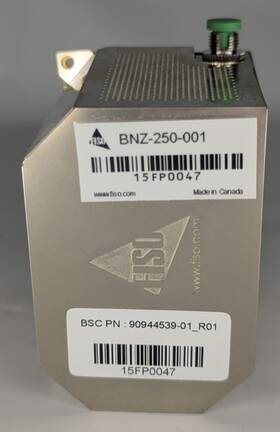
( Brand: Fiso ), ( Manufacturer Part Number: BNZ-250-002 ), ( Part Type: Sensor Module )
Review FISO Fiber Optic Sensor Module
The **FISO BNZ-250-002 (and its variant, the BNZ-250-001)** is a high-performance, fiber-optic sensor module designed for precision measurement in demanding industrial, scientific, and research applications. Engineered with cutting-edge fiber-optic technology, this compact yet robust module excels in environments where traditional electrical sensors may fall short such as in high-voltage, explosive, or corrosive settings thanks to its immunity to electromagnetic interference (EMI) and electrical noise. The BNZ-250 series leverages **Brillouin scattering** principles to deliver unparalleled accuracy in strain, temperature, and vibration monitoring, making it ideal for structural health monitoring (SHM), pipeline integrity assessment, and advanced materials testing.
At its core, the BNZ-250-002 (and its counterpart, the BNZ-250-001) features a **high-resolution Brillouin optical time-domain analyzer (BOTDA)** architecture, enabling real-time, distributed sensing over long distances up to **250 meters** (or configurable lengths) with a spatial resolution as fine as **1 meter**. This distributed sensing capability allows for continuous, high-density data acquisition along the fiber optic cable, eliminating the need for discrete sensors and reducing installation complexity. The module s **dual-wavelength Brillouin pump-probe technique** ensures exceptional sensitivity, detecting even subtle changes in strain or temperature with minimal signal attenuation, even in harsh conditions.
Built for durability, the BNZ-250 series incorporates a **ruggedized enclosure** with IP67 ingress protection, safeguarding internal components from dust, moisture, and mechanical stress. The module s **single-mode fiber optic interface** (compatible with standard SMF-28 or equivalent) ensures seamless integration into existing fiber networks, while its **compact, modular design** allows for easy deployment in field applications, laboratory setups, or embedded systems. Whether monitoring the structural integrity of bridges, assessing the health of offshore wind turbines, or conducting precision experiments in materials science, the BNZ-250-002 and BNZ-250-001 provide a **versatile, non-intrusive solution** for critical sensing requirements.
For researchers and engineers seeking **high-fidelity data** with minimal signal degradation, the BNZ-250 series delivers **sub-millistrain resolution** and **sub-degree Celsius temperature accuracy**, making it indispensable for applications where precision is non-negotiable. Its **software-driven configuration** via a user-friendly interface allows for customizable measurement parameters, including sampling rates, averaging windows, and alarm thresholds, ensuring optimal performance for diverse use cases. Whether deployed in **industrial process monitoring, civil infrastructure assessment, or advanced scientific research**, the FISO BNZ-250-002 and BNZ-250-001 represent a **next-generation fiber-optic sensor** that redefines the boundaries of distributed sensing technology.
The **FISO BNZ-250-001** and **BNZ-250-002** are fiber optic sensor modules designed for high-precision strain, vibration, and dynamic measurement applications. Below is a detailed analysis of their pros and cons, followed by a conclusion and recommendation.
---
### **Pros of the FISO BNZ-250 Modules**
1. **High Precision and Sensitivity**
The BNZ-250 series is known for its exceptional sensitivity, making it suitable for detecting very small displacements, strains, or vibrations. This is particularly useful in research, aerospace, and industrial testing where fine measurements are critical.
2. **Fiber Optic Technology Advantages**
- **Electromagnetic Immunity**: Unlike electrical sensors, fiber optic sensors are immune to electromagnetic interference (EMI), making them ideal for environments with strong magnetic fields or high-voltage equipment.
- **Lightweight and Small Form Factor**: The compact design allows for easy integration into small or hard-to-reach measurement points.
- **Durability**: Fiber optic cables are resistant to corrosion, moisture, and extreme temperatures, enhancing long-term reliability in harsh conditions.
3. **Wide Measurement Range**
The BNZ-250 modules can measure both static and dynamic strains/vibrations over a broad range, depending on the specific configuration and accessories used. This versatility makes them adaptable to various applications, from structural health monitoring to acoustic testing.
4. **High Bandwidth and Fast Response**
These sensors are capable of capturing high-frequency signals, which is essential for dynamic testing, modal analysis, and transient event monitoring. The response time is typically in the nanosecond range, depending on the setup.
5. **Compatibility with FISO s Ecosystem**
The BNZ-250 modules are part of FISO s broader line of fiber optic sensors and are designed to work seamlessly with their data acquisition systems (e.g., FISO DAQ units, oscilloscopes, or third-party systems via appropriate interfaces). This compatibility simplifies system integration and reduces setup complexity.
6. **Non-Contact Measurement Capability**
In some configurations, these sensors can be used for non-contact measurements (e.g., via interferometric techniques), which eliminates the risk of altering the system under test by attaching a sensor directly.
7. **Low Thermal Drift**
Fiber optic sensors generally exhibit minimal thermal drift compared to electrical sensors, which is advantageous for long-duration experiments or applications where temperature stability is critical.
8. **Modular and Customizable**
The BNZ-250 modules can be paired with various fiber optic probes, connectors, and accessories to tailor the sensor to specific measurement requirements (e.g., different gauge lengths, tip styles, or environmental protections).
9. **Long-Term Stability**
Fiber optic sensors are known for their stability over extended periods, making them reliable for field deployments or continuous monitoring applications.
10. **Support for Advanced Techniques**
The BNZ-250 modules support advanced measurement techniques such as phase-sensitive detection, which improves signal clarity and reduces noise in challenging environments.
---
### **Cons of the FISO BNZ-250 Modules**
1. **High Cost**
Fiber optic sensors, particularly high-performance models like the BNZ-250 series, are significantly more expensive than traditional electrical sensors (e.g., strain gauges or accelerometers). The cost includes not only the sensor itself but also the necessary fiber optic cables, connectors, and sometimes specialized optics or electronics. This can be a barrier for budget-conscious projects or small-scale research.
2. **Complex Setup and Calibration**
Fiber optic sensors require careful handling during installation to avoid damaging the delicate fiber optics. Proper alignment, splicing, and calibration are often needed, which may demand specialized training or expertise. This can increase the time and effort required for system integration compared to plug-and-play electrical sensors.
3. **Limited Availability of Technical Support**
While FISO provides documentation and support, the niche nature of fiber optic sensors may result in slower response times for troubleshooting or customization requests compared to more mainstream sensor technologies. Users may need to invest time in learning the intricacies of fiber optic measurement systems.
4. **Potential for Fiber Damage**
The fiber optic cables and connectors are fragile. Improper handling during installation, testing, or field deployment can lead to breaks or misalignments, which may require costly repairs or replacements. This risk is higher in dynamic or high-stress environments.
5. **Requires Specialized Equipment for Testing**
To fully utilize the BNZ-250 modules, users may need access to specialized equipment such as fiber optic oscilloscopes, laser sources, or photodetectors. This can add to the overall cost of ownership and may not be available in all laboratories or field settings.
6. **Learning Curve for Users**
The principles of fiber optic sensing (e.g., interferometry, phase detection) differ from traditional electrical sensing. Users unfamiliar with these concepts may require additional training to effectively deploy and interpret data from the BNZ-250 modules.
7. **Limited Off-the-Shelf Accessories**
While FISO offers a range of accessories, the selection may not be as extensive as that for electrical sensors. Users might need to source custom or third-party components to meet specific requirements, which can complicate the procurement process.
8. **Environmental Limitations**
Although fiber optic sensors are generally robust, extreme conditions (e.g., very high temperatures, chemical exposure, or mechanical stress) can still pose challenges. For example, some fiber optic connectors or splices may not perform optimally in very harsh environments, requiring additional protective measures.
9. **Signal Processing Complexity**
The raw output of fiber optic sensors often requires post-processing (e.g., demodulation, filtering) to extract meaningful data. This may involve additional software or hardware, adding complexity to the data acquisition workflow.
10. **Compatibility Issues with Non-FISO Systems**
While the BNZ-250 modules can interface with third-party systems, ensuring seamless integration may require additional adapters or custom solutions. This can introduce compatibility risks or additional costs if the system is not properly configured.
---
### **Conclusion**
The **FISO BNZ-250-001 and BNZ-250-002** are high-performance fiber optic sensor modules that excel in applications requiring precision, electromagnetic immunity, and durability. Their advantages in sensitivity, bandwidth, and environmental resistance make them ideal for advanced research, aerospace, and industrial testing. However, their high cost, complex setup, and specialized requirements can be significant drawbacks, particularly for users with limited budgets or experience in fiber optic sensing.
The decision to purchase these modules should be based on the specific needs of the project:- **If your application demands high precision, EMI immunity, or dynamic measurement in harsh environments**, the BNZ-250 modules are an excellent choice despite their higher cost and complexity.
- **If budget constraints or simplicity are priorities**, traditional electrical sensors (e.g., strain gauges or accelerometers) may be more suitable, provided they meet the performance requirements of your application.
---
### **Recommendation**
1. **Assess Your Requirements**:- Determine whether the unique advantages of fiber optic sensing (e.g., EMI immunity, non-contact measurement) are critical for your application. If not, consider alternative sensors.
- Evaluate the cost of the BNZ-250 modules against the total project budget, including accessories, installation, and potential training needs.
2. **Evaluate Long-Term Value**:- Weigh the initial investment against the long-term benefits, such as reduced maintenance, durability, and the ability to capture high-quality data that might not be possible with other sensors.
3. **Seek Expert Guidance**:- Consult with FISO or a fiber optic sensing specialist to ensure the BNZ-250 modules are the right fit for your application. They can provide insights on system integration, calibration, and troubleshooting.
4. **Start with a Pilot Test**:- If possible, test the BNZ-250 modules in a controlled environment before committing to a full deployment. This will help you evaluate their performance in your specific use case and identify any challenges early.
5. **Consider Alternatives**:- If the BNZ-250 modules are too expensive or complex, explore other fiber optic sensor options from FISO (e.g., lower-cost models) or alternative technologies (e.g., capacitive, piezoelectric, or laser-based sensors) that might better suit your needs.
6. **Plan for Training and Support**:- Ensure your team has access to training resources or support from FISO to maximize the effectiveness of the sensors. Proper training can mitigate many of the challenges associated with fiber optic sensing.
**Final Verdict**:The **FISO BNZ-250-001 and BNZ-250-002** are **highly recommended for applications where their unique capabilities are essential**, such as advanced aerospace testing, structural health monitoring, or high-precision dynamic measurements in EMI-prone environments. For less demanding applications, however, the investment may not be justified, and alternative sensors should be considered. Always conduct a thorough cost-benefit analysis and pilot test before making a final decision.
Details:
May show signs of previous use such as scuffs, scratches, faded labels, or sticker residue. Used and in good condition. You are purchasing one 1 used item.
part #: bnz250002 prices
- $460.00-$580.20
specifications automationjack:
- brand: Fiso
- mpn: Bnz-250-002
- part type: Sensor Module
seller automationjack:
- city: Hudson, Wisconsin
- # reviews: 296
- rating: 98.1%
returns automationjack:
- method: Money back
- time: 30 Days
- paid by: Buyer
- policy: Returns Accepted
payments automationjack:
- wallet: Paypal
- credit card: Visa
- other
shipping automationjack:
- transit: 4-11 Days
- class: Standard
- service: USPS Ground Advantage
- carrier: USPS
- type: Calculated
- cost: $0.00
general automationjack:
- Business Industrial > Industrial Automation Motion Controls > Other Automation Equipment
- condition: Used
offer automationjack:
- availability: In Stock
- options: Ship-to-home
- best offers: True
- sold: 0
- started: February 8, 2026