BALLUFF BES04AW Bes Q40KFU-PAC20A
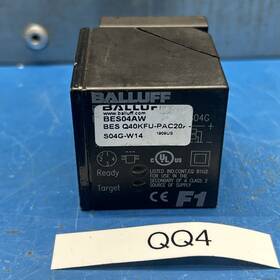
( Brand: Balluff ), ( Manufacturer Part Number: BES04AW )
Review BALLUFF Bes Fast Shipping Warranty
The **Balluff BES04AW BES-Q40KFU-PAC20A** is a high-performance, compact inductive proximity sensor designed for demanding industrial applications where reliability, precision, and robustness are paramount. This sensor belongs to the **BES-Q40KFU** series, which is engineered to deliver exceptional performance in harsh environments, making it an ideal choice for automation, material handling, and process control systems. The **BES04AW** variant features a **4mm diameter** sensing face, allowing for precise detection in tight spaces while maintaining a robust and durable construction. Its **PNP (Normally Open) output** with a **20A current rating** ensures compatibility with a wide range of control systems, providing a stable and reliable switching signal for applications requiring strong drive capabilities, such as motor starters, solenoids, or high-power relays.
This sensor incorporates **Balluff s advanced inductive technology**, which ensures consistent and repeatable detection of metallic targets regardless of surface condition, coating, or orientation. The **Q40KFU** model is specifically optimized for **high-speed applications**, offering an **ultra-fast response time** and minimal hysteresis, making it suitable for dynamic environments where rapid target transitions occur. The sensor s **IP67 rating** guarantees protection against dust, dirt, and temporary immersion in water, while its **M18 threaded housing** provides a secure and vibration-resistant mounting solution, ideal for use on conveyor systems, robotic arms, or other machinery subjected to mechanical stress. Additionally, the **AW (Amber) LED indicator** provides immediate visual feedback on the sensor s operational status, allowing for quick troubleshooting and maintenance checks.
Beyond its technical specifications, the **BES04AW BES-Q40KFU-PAC20A** stands out for its **long-term reliability and low maintenance requirements**, thanks to Balluff s commitment to high-quality manufacturing and rigorous quality control. The sensor s **wide operating temperature range** (from **-25 C to 85 C**) ensures consistent performance across diverse industrial settings, whether in cold storage facilities, high-temperature processing lines, or outdoor applications. Its **compact yet sturdy design** also makes it versatile for retrofitting existing systems without requiring significant modifications, while its **compatibility with Balluff s extensive range of accessories**, such as mounting brackets, cable glands, and connection kits, further enhances its adaptability. Whether deployed in automotive assembly lines, packaging machinery, or material sorting systems, this sensor delivers the precision, durability, and efficiency needed to optimize productivity while minimizing downtime.
**Balluff BES04AW-BES-Q40KFU-PAC20A: Pros and Cons**
This product is a **Balluff inductive proximity sensor** designed for industrial applications, specifically a **through-bead sensor** with a **PAC20A** (PNP) output and a **40mm** sensing range. Below is a detailed analysis of its advantages and disadvantages.
---
### **Pros**
1. **High Reliability and Durability**
Balluff is a well-established manufacturer known for producing high-quality, robust sensors. This model is built for harsh industrial environments, featuring **IP67/IP69K** protection, making it resistant to dust, water, and high-pressure cleaning. The through-bead design ensures long-term reliability by protecting internal components from contamination.
2. **Wide Sensing Range (40mm)**
The **40mm sensing range** provides flexibility for various applications, allowing detection of targets at a moderate distance. This range is suitable for many industrial processes where precise but not ultra-close detection is required.
3. **PNP Output (PAC20A)**
The **PNP (normally open) output** is a standard and widely compatible signal type in industrial automation. It is easier to integrate with PLCs, relays, and other control systems compared to other output types like NPN or analog signals.
4. **Compact and Easy to Install**
The sensor has a **compact design**, making it suitable for applications with limited space. The **M12 connector** ensures secure and reliable wiring, reducing the risk of loose connections.
5. **Low Power Consumption**
Inductive sensors like this one typically consume very little power (typically **
6. **Compatibility with Various Materials**
Inductive sensors detect **ferromagnetic materials** (e.g., steel, iron, aluminum with ferromagnetic coatings). This model is likely optimized for common industrial metals, ensuring consistent performance in metal-detection applications.
7. **Balluff s Quality and Support**
Balluff is part of the **ifm efector Group**, a leader in industrial automation sensors. This brand offers **strong technical support, extensive documentation, and global availability of spare parts**, reducing downtime in case of failures.
8. **No Moving Parts**
Since inductive sensors use **electromagnetic fields** rather than mechanical switches, they have **no wear-and-tear components**, leading to longer lifespan and reduced maintenance.
9. **Compatibility with Common Control Systems**
The **PNP output** is universally recognized in PLCs (e.g., Siemens, Allen-Bradley, Rockwell), making integration straightforward without additional converters.
10. **Cost-Effective for Many Applications**
While not the cheapest sensor on the market, its **reliability, durability, and ease of use** often justify the cost in industrial settings where uptime is critical.
---
### **Cons**
1. **Limited to Ferromagnetic Materials**
Unlike capacitive or photoelectric sensors, inductive sensors **only detect ferromagnetic metals**. Non-ferrous materials (e.g., pure aluminum, copper, or plastics) will not be detected, which may limit its use in certain applications.
2. **Sensing Range Limitations**
While the **40mm range is useful**, it may be **too short for some applications** requiring longer detection distances. Conversely, if the target is too close, the sensor may not trigger reliably due to the **dead zone** near the sensor face.
3. **Potential for False Triggers with Non-Ferrous Coatings**
If the target has a **non-ferrous coating** (e.g., plastic, rubber, or anodized aluminum), the sensor may not detect it properly, leading to false negatives.
4. **Sensitivity to Metal Thickness and Shape**
The sensor s performance can vary based on the **thickness and shape of the target**. Thin or irregularly shaped ferromagnetic materials may not be detected consistently.
5. **No Built-in Diagnostics (Basic Model)**
This specific model does not appear to include **advanced diagnostic features** (e.g., self-test, communication protocols like PROFIBUS or IO-Link). Users may need additional tools to monitor sensor health.
6. **Cost Compared to Simpler Sensors**
While not expensive, it may be **more costly than basic inductive sensors** with shorter ranges or simpler outputs. For applications requiring only **short-range detection**, a cheaper alternative might suffice.
7. **Wiring and Installation Complexity**
Although the **M12 connector is reliable**, improper wiring or installation (e.g., incorrect polarity, loose connections) can lead to malfunctions. Some users may require additional mounting hardware (e.g., brackets, guides) for optimal performance.
8. **Limited Customization Options**
Unlike some high-end sensors, this model does not offer **adjustable sensitivity or range settings**, which may restrict its use in applications requiring fine-tuned detection parameters.
9. **Potential Interference from Nearby Electronics**
In **high-electromagnetic interference (EMI) environments**, inductive sensors may experience **noise-induced false triggers**. Shielding or proper grounding may be necessary.
10. **Replacement Parts Dependency on Balluff**
While Balluff has a strong reputation, **reliance on their ecosystem** means that spare parts or replacements may not be as readily available as generic brands in some regions.
---
### **Conclusion**
The **Balluff BES04AW-BES-Q40KFU-PAC20A** is a **high-quality, reliable inductive proximity sensor** well-suited for **industrial applications requiring detection of ferromagnetic materials** within a **40mm range**. Its **durability (IP67/IP69K), PNP output compatibility, and low maintenance requirements** make it a strong choice for **automation, material handling, and manufacturing processes** where consistent performance is critical.
However, its **limited material detection (ferromagnetic only), fixed sensing range, and lack of advanced diagnostics** may make it less ideal for **highly specialized or non-metallic applications**. Additionally, while it is **cost-effective for many industrial uses**, budget-conscious buyers may explore alternatives if their requirements are simpler.
For most **standard industrial metal-detection tasks**, this sensor provides **excellent value** due to Balluff s reputation for **reliability and support**. If the application involves **non-ferrous materials, very long ranges, or requires advanced diagnostics**, a different sensor type (e.g., capacitive, photoelectric, or IO-Link-enabled) may be more appropriate.
---
### **Recommendation**
**Buy this sensor if:**- You need a **reliable, durable inductive sensor** for **ferromagnetic metal detection** in an **industrial environment**.
- Your application requires a **40mm sensing range** with **PNP output compatibility**.
- You prioritize **low maintenance, high IP ratings (IP67/IP69K), and Balluff s brand reliability**.
- Your budget allows for a **premium but cost-effective** solution with long-term support.
**Consider alternatives if:**- You require **detection of non-ferrous materials** (e.g., aluminum, plastics) **Capacitive or photoelectric sensors** may be better.
- You need **longer or adjustable sensing ranges** Look for sensors with **extended ranges (e.g., 100mm ) or adjustable sensitivity**.
- Your application demands **advanced diagnostics or communication protocols** (e.g., IO-Link, PROFIBUS) **Higher-end Balluff or other brand sensors** with these features may be necessary.
- You are working with **very tight spaces or unique mounting constraints** Verify compatibility with mounting hardware before purchase.
**Final Verdict:**This sensor is an **excellent choice for most standard industrial metal-detection applications** where reliability and ease of integration are key. For specialized or non-standard requirements, a more tailored sensor may be preferable.
Details:
We review all offers in a timely manner. Have a great day. All in great condition.
part #: bes04aw prices
- $46.54-$160.31
specifications automationjack:
- brand: Balluff
- mpn: Bes04aw
seller automationjack:
- # reviews: 18233
- rating: 99.9%
- city: New Paris, Indiana
returns automationjack:
- time: 30 Days
- method: Money back
- policy: Returns Accepted
- paid by: Buyer
general automationjack:
- condition: Used
- Business Industrial > Industrial Automation Motion Controls > Other Automation Equipment
offer automationjack:
- options: Ship-to-home
- best offers: True
- availability: In Stock
- quantity: 7
- sold: 0
- started: March 27, 2026
shipping automationjack:
- cost: $15.79
- transit: 3-6 Days
- class: Standard
- service: UPS Ground
- type: Calculated
- carrier: UPS
payments automationjack:
- other
- cash
- credit card: Discover
- wallet: Paypal
- money order
- check
Balluff BES04AW Is Similar To:
- Balluff Bgl000r Bgl20a-001-s49 10-30v Dc Free Shipping (46.4% similar) Balluff BGL000R BGL20A-001-S49 10-30V dc free shipping used but in good working order...(February 3rd, 2024)
- Balluff Bes0457 Inductive Sensor Bes Q40kfu-pac20a-s04g-w0 310080 (56.5% similar) Balluff BES0457. Style: 40X40. Manufacturer part number: BES0457. Range: 20MM...(August 18th, 2024)
- Balluff 516-324-e4-c-s4-01 Bes 5 Inductive Proximity Switch 10-30vdc 232625 (31.3% similar) Balluff bes 516-324-E4-C-S4-01,5, inductive proximity switch, 10-30VDC. Manufacturer part number: bes 516-324-E4-C-S4-01,5. Alt id: BES00NF. Balluff bes 516-324-E4-C-S4-01,5...(April 15th, 2025)
- Balluff 516-324-e4-c-s4-00 Bes 5 Inductive Sensor 10-30 V Dc 232596 (31.7% similar) Manufacturer part number: bes 516-324-E4-C-S4-00,5. Alt id: BES00NA. Balluff bes 516-324-E4-C-S4-00,5, inductive sensor, 10-30 v dc. Balluff bes 516-324-E4-C-S4-00,5...(April 19th, 2025)
- Balluff Bhs003j Inductive Sensors Bes 516-300-s295 1.025 Inch s4 331225 (34.8% similar) Balluff BHS003J. Balluff BHS003J, inductive sensors. Alt id: bes 516-300-S295/1.025 -S4. Manufacturer part number: BHS003J...(April 20th, 2025)
- Balluff M30ee1-psc40f-s04g-s Bes Inductive Sensor 283219 (41.7% similar) Balluff bes M30EE1-PSC40F-S04G-S. Style: M30 x 1.5. Manufacturer part number: bes M30EE1-PSC40F-S04G-S. Range: 40MM...(April 23rd, 2025)
- Balluff M12mg-usc30b-bv05 Bes Sensor (36.2% similar) Bes M12MG-USC30B-BV05...(June 2nd, 2025)
- Balluff 516-3019-e4-y-pu Bes Sensor (36.6% similar) Bes 516-3019-E4-Y-PU...(June 3rd, 2025)
- Balluff 516-542-bo-h Bes Sensor (38.2% similar) Bes 516-542-BO-H...(June 3rd, 2025)
- Balluff 516-325-g-s4-c Bes Inductive Proximity Sensor Bes01c7 (31.9% similar) Balluff bes 516-325-G-S4-C inductive proximity sensor BES01C7. Ryan MRI sells factory new and pre-owned surplus products develops channels to purchase such product...(November 22nd, 2025)
- Balluff Q40kfu-pac35e-s04g-w01 Bes Inductive Proximity Sensor (40.3% similar) Ryan MRI sells factory new and pre-owned surplus products develops channels to purchase such product. Balluff bes Q40KFU-PAC35E-S04G-W01 inductive proximity sensor...(November 23rd, 2025)