KISTLER 8630C50 Piezobeam Accelerometer Mv 50G 100.2 Mv/g
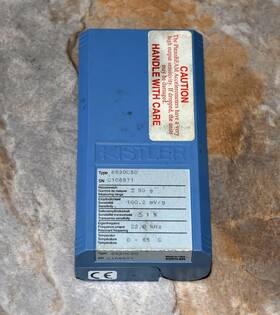
( Brand: Kistler ), ( Manufacturer Part Number: 8630C50 ), ( Part Type: Case ), ( Country Of Origin: Switzerland )
Review KISTLER Piezobeam Accelerometer 50g Mv/g Case
The **Kistler 8630C50 Piezobeam Accelerometer** is a high-performance, miniature piezoelectric accelerometer designed for precision dynamic measurement in demanding industrial, automotive, and research applications. Engineered with Kistler s advanced piezoceramic technology, this accelerometer delivers exceptional sensitivity and reliability within a compact, robust housing measuring just 50 mm in length, making it ideal for space-constrained environments where traditional larger sensors would be impractical. With a sensitivity of **100.2 mV/g**, it provides a balanced output for accurate signal processing, ensuring high-resolution data capture across a broad frequency range while maintaining low noise levels. The sensor s **50g** range accommodates a wide variety of applications, from structural vibration analysis and crash testing to engine diagnostics and aerospace structural health monitoring, where dynamic forces must be measured with both precision and repeatability.
The 8630C50 features a **piezoceramic beam design**, which enhances durability and minimizes mechanical interference, making it resistant to environmental factors such as moisture, dust, and temperature fluctuations within its operational range of **-40 C to 125 C**. Its **IEPE (Integrated Electronics Piezoelectric) output** simplifies signal conditioning by eliminating the need for external charge amplifiers, allowing for direct connection to data acquisition systems with built-in excitation. The accelerometer s **low mass (approximately 15 grams)** ensures minimal disturbance to the test subject, reducing measurement errors in high-frequency applications. Additionally, its **M12 threaded connection** provides secure mounting flexibility, accommodating various adapters and fixtures for versatile installation on surfaces, structures, or even within enclosed systems.
Designed for long-term reliability, the 8630C50 incorporates Kistler s proprietary **piezoceramic material and sealing technology**, ensuring consistent performance over extended use cycles. Its **low thermal drift** and **high overload protection** (up to 2,000g) further reinforce its suitability for harsh operational conditions, where reliability is critical. Whether deployed in automotive crash testing, wind tunnel experiments, or industrial machinery diagnostics, this accelerometer excels in capturing high-fidelity dynamic data with minimal signal degradation. Engineers and researchers can trust its **linear response and low noise floor** to deliver accurate, actionable insights, making it a cornerstone for advanced vibration analysis, modal testing, and structural integrity assessments.
The **Kistler 8630C50 Piezobeam Accelerometer (50g, 100.2 mV/g)** is a high-performance, piezoelectric accelerometer commonly used in vibration measurement, structural health monitoring, and dynamic testing. Below is a detailed analysis of its pros and cons, followed by a concluding recommendation.
---
### **Pros**
1. **High Sensitivity and Accuracy**
The accelerometer has a sensitivity of **100.2 mV/g**, which is relatively high for piezoelectric sensors. This means it can detect small vibrations with precision, making it suitable for applications requiring fine resolution, such as fatigue testing, modal analysis, or precision machinery monitoring.
2. **Wide Frequency Range**
With a frequency range typically extending from **0.5 Hz to 10,000 Hz** (depending on mounting and charge amplifier settings), it is versatile for both low-frequency (e.g., structural dynamics) and high-frequency (e.g., machinery diagnostics) applications.
3. **Durability and Robustness**
Kistler sensors are known for their **high durability**, capable of withstanding harsh environments, including high temperatures (up to 250 C with certain models) and shock loads (rated for **50g peak acceleration**). The **piezoceramic beam design** ensures mechanical stability under dynamic loads.
4. **Compatibility with Charge Amplifiers**
As a piezoelectric sensor, it requires a **charge amplifier** (e.g., Kistler 5135A or 5133B) for signal conditioning. Kistler s charge amplifiers are optimized for this sensor, providing stable, low-noise output and easy integration into data acquisition systems.
5. **Low Noise and High Signal-to-Noise Ratio**
Piezoelectric sensors like this one generally exhibit **low inherent noise**, making them ideal for applications where signal clarity is critical, such as in aerospace, automotive, or research settings.
6. **Modular and Customizable Mounting**
The accelerometer can be mounted using **magnetic bases, adhesive, or threaded studs**, offering flexibility depending on the application. This adaptability is useful in field testing or laboratory environments.
7. **Industry Standard and Reliability**
Kistler is a well-established brand in vibration measurement with a reputation for **long-term reliability**. The 8630 series is widely used in research, testing, and industrial applications, ensuring availability of spare parts and technical support.
8. **Calibration and Traceability**
Kistler sensors are often **pre-calibrated** and can be traceable to national standards, which is important for compliance in regulated industries (e.g., aerospace, automotive).
---
### **Cons**
1. **Requires Charge Amplifier**
Unlike IEPE (Integrated Electronics Piezoelectric) sensors, this accelerometer **cannot operate without an external charge amplifier**. This adds complexity and cost to the system, as you must purchase and maintain a compatible amplifier.
2. **DC Offset Limitations**
Piezoelectric sensors **cannot measure static acceleration (DC signals)** due to their charge-based operation. For static or quasi-static measurements, an **ICP or MEMS accelerometer** would be more appropriate.
3. **Sensitivity to Temperature and Humidity**
While robust, piezoelectric sensors can be **affected by temperature fluctuations**, which may cause drift in sensitivity. The 8630C50 has a **temperature range of -40 C to 120 C**, but extreme conditions may require additional compensation or calibration.
4. **Mechanical Mounting Challenges**
Improper mounting (e.g., loose attachment, misalignment) can introduce **resonance or noise**, compromising measurement accuracy. Unlike MEMS sensors, piezoelectric accelerometers require careful installation to avoid artifacts.
5. **Cost of System Components**
Beyond the accelerometer itself, the **charge amplifier, cables, and mounting hardware** add to the total cost. For some applications, a **single-channel ICP or MEMS accelerometer** may be more cost-effective.
6. **Limited Dynamic Range for Very Low Frequencies**
While it performs well in mid-to-high frequencies, **very low-frequency vibrations (below 1 Hz)** may require additional signal processing or filtering, as piezoelectric sensors can exhibit **low-frequency noise**.
7. **Not Ideal for High-Temperature Applications Without Modifications**
While the 8630C50 can handle up to **120 C**, some industrial or aerospace applications may require **high-temperature variants** (e.g., Kistler 8635A), which are more expensive.
8. **Signal Cabling and Grounding Sensitivity**
Piezoelectric sensors are **high-impedance devices**, making them sensitive to **cable noise and grounding issues**. Proper shielding and cable management are essential to avoid interference.
---
### **Recommendation**
The **Kistler 8630C50 Piezobeam Accelerometer** is an **excellent choice** for applications requiring **high sensitivity, wide frequency range, and durability** in dynamic vibration measurement. Its strengths lie in **precision, reliability, and compatibility with Kistler s ecosystem of charge amplifiers and data acquisition systems**, making it ideal for:
- **Structural health monitoring** (bridges, buildings, wind turbines)
- **Modal analysis and fatigue testing** in research and development
- **Automotive and aerospace diagnostics** (engine vibration, crash testing)
- **Precision machinery monitoring** (industrial equipment, robotics)
However, it is **not suitable** for applications requiring:- **Static acceleration measurement** (use an ICP or MEMS sensor instead)
- **Simplified, low-cost systems** (where a single-channel MEMS accelerometer may suffice)
- **Extreme high-temperature environments** (consider a high-temperature piezoelectric model)
- **Portable or battery-powered systems** (due to the need for an external charge amplifier)
#### **Final Recommendation:** **Buy the Kistler 8630C50 if:**- You need **high-precision, wide-range vibration measurement** in a controlled or industrial setting.
- You are already using **Kistler charge amplifiers and data acquisition systems**, ensuring compatibility.
- Your application involves **dynamic testing, modal analysis, or structural monitoring** where sensitivity and durability are critical.
**Avoid the Kistler 8630C50 if:**- You require **static or low-frequency DC measurements** (opt for an ICP or MEMS sensor).
- Your budget is constrained, as the **total system cost (accelerometer amplifier cables)** may be higher than alternative solutions.
- You need a **plug-and-play, battery-powered, or wireless** solution (MEMS sensors like PCB Piezotronics or Endevco may be better).
For most **professional vibration measurement applications**, the 8630C50 remains a **superior choice** due to its performance and reliability, provided the system requirements align with its limitations. Pair it with a **high-quality charge amplifier (e.g., Kistler 5135A)** and proper mounting techniques to maximize accuracy.
Details:
The accelerometer shows normal cosmetic wear from prior use, including scuffs/marks. This unit was removed from a lab environment in working condition, but I do not have the equipment to test or re calibrate it after removal. Please see photos for exact condition and included items. Calibration status is unknown, and no calibration certificate included.
The case label lists the following specifications Kistler storage. Sensitivity: 100.2 mV/g. Important note: The case label and accelerometer appear to show different serial numbers. For sale is a Kistler 8630C50 PiezoBEAM Accelerometer removed from lab in working condition.
The case label lists the following specifications: Measuring range: 50 g. The storage case also shows wear. The accelerometer is marked Kistler 8630C50 and includes a storage case.
part #: 8630c50 price
- $249.95
specifications automationjack:
- brand: Kistler
- mpn: 8630c50
- part type: Case
- country of origin: Switzerland
general automationjack:
- condition: Used
- Business Industrial > Industrial Automation Motion Controls > Other Automation Equipment
seller automationjack:
- city: Belle e, Pennsylvania
- # reviews: 3272
- rating: 100.0%
shipping automationjack:
- service: FedEx Ground / FedEx Home Delivery
- transit: 4-7 Days
- type: Calculated
- cost: $22.57
- carrier: FedEx
- class: Standard
returns automationjack:
- policy: Returns Accepted
- method: Money back
- paid by: Buyer
- time: 30 Days
payments automationjack:
- credit card: Mastercard
- other
- wallet: Google-pay
offer automationjack:
- quantity: 1
- availability: In Stock
- best offers: True
- started: May 8, 2026
- options: Ship-to-home
- sold: 0
Kistler 8630C50 Is Similar To:
- Kistler 8628a50 Accelerometer Magnetic Pair With Original Box (57.6% similar) Tested and working. This item was pulled from a working environment. Only items included in pictures are the sale. Please look at all photos before purchasing...(August 28th, 2025)