NOVUS AUTOMATION 8202011300 Prra Temperature Controller N2020 1/8DIN 96X48MM
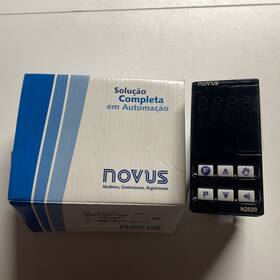
( Brand: Novus Automation ), ( Manufacturer Part Number: 8202011300 ), ( Model: N2020 1 ), ( Type: Panel Mounted Pid Digital Controller ), ( Unit Type: Unit ), ( Custom Bundle: No ), ( Country Of Origin: Brazil )
Review NOVUS AUTOMATION Prra 1/8din 96x48mm Temperature Controller Pn
The **Novus Automation 8202011300 N2020 PRRA 1/8 DIN Temperature Controller** is a high-performance, precision-engineered device designed to deliver reliable and efficient temperature regulation for a wide range of industrial, laboratory, and commercial applications. Part of Novus Automation s advanced N2020 series, this compact yet robust controller combines cutting-edge technology with user-friendly functionality to ensure seamless operation in demanding environments. Measuring just **96x48mm**, the 1/8 DIN form factor makes it ideal for installation in tight spaces, such as control panels, machinery enclosures, or laboratory setups where space optimization is critical. Its sleek, modular design not only enhances aesthetics but also allows for easy integration into existing systems, whether in manufacturing, HVAC, food processing, or scientific research facilities.
At its core, the N2020 PRRA excels in precision temperature control, offering a **high-resolution display** with intuitive navigation via its front-panel controls, including a backlit LCD screen that provides real-time monitoring of setpoints, actual temperatures, and system status. The controller supports **PID (Proportional-Integral-Derivative) control algorithms**, enabling fine-tuned regulation for applications requiring exact temperature stability, such as heating or cooling processes in chemical reactions, medical equipment calibration, or climate-controlled storage. With adjustable parameters for gain, reset, and rate, users can optimize performance to match specific process requirements, ensuring consistency and efficiency.
Safety and reliability are prioritized in the N2020 PRRA, which features **multiple protection mechanisms** to safeguard both the system and the operator. These include **over-temperature and over-current protection**, as well as **short-circuit and open-circuit detection**, preventing damage to connected components such as heaters, cooling units, or sensors. The controller also supports **remote sensing** via its built-in **K-type, J-type, T-type, or N-type thermocouple inputs**, as well as **PT100/PT1000 resistance temperature detector (RTD) inputs**, allowing for accurate temperature measurement at the process point rather than at the controller itself. This minimizes measurement errors and ensures precise control, even in environments with significant temperature gradients.
Connectivity and expandability are key strengths of this controller, as it offers **modular I/O options** to accommodate diverse system requirements. The N2020 PRRA includes **relay outputs** for direct control of actuators, solenoids, or contactors, while its **analog output** (0-10V or 4-20mA) enables integration with PLCs, data loggers, or other automation systems. Additionally, the controller supports **RS-485 communication via Modbus RTU**, facilitating seamless integration into larger control networks, allowing for remote monitoring, programming, and diagnostics. This versatility makes it suitable for both standalone applications and complex, distributed control systems.
Novus Automation has engineered the N2020 PRRA with **durability and longevity** in mind, utilizing high-quality components and a robust construction that withstands harsh conditions, including temperature fluctuations, vibration, and electrical noise. The controller operates within a wide **ambient temperature range**, typically from **-20 C to 70 C**, ensuring reliable performance in both indoor and outdoor applications. Its **low power consumption** further enhances its efficiency, making it an economical choice for long-term operation without compromising performance.
Whether deployed in **industrial manufacturing** for process temperature regulation, **laboratory settings** for precise experimental conditions, or **HVAC systems** for climate control, the Novus Automation 8202011300 N2020 PRRA delivers a blend of **accuracy, flexibility, and reliability**. Its combination of advanced control algorithms, robust protection features, and seamless integration capabilities positions it as a versatile and dependable solution for professionals who demand precision and efficiency in their temperature control applications. With minimal maintenance requirements and a focus on user accessibility, this controller stands as a testament to Novus Automation s commitment to delivering high-performance automation solutions tailored to modern industrial needs.
### **Pros and Cons of buying a Novus Automation 8202011300 N2020 PRRA (1/8 DIN, 96x48mm) Temperature Controller**
#### **Pros:**1. **Precision and Reliability** The N2020 series is known for its high-precision temperature control, making it suitable for applications requiring tight tolerances, such as industrial processes, laboratory equipment, or HVAC systems.
2. **Compact Design (1/8 DIN, 96x48mm)** The small form factor allows for space-efficient installation in control panels, dashboards, or embedded systems where space is limited.
3. **Modular and Programmable** Supports PID control with adjustable parameters (proportional, integral, derivative gains), allowing fine-tuning for different load types and response requirements.
4. **Multiple Input/Output Options** Compatible with various sensors (RTD, thermocouples, resistance inputs) and supports relay, transistor, or analog output control, providing flexibility for different control scenarios.
5. **Digital Communication Protocols** Supports Modbus RTU/RS-485, enabling integration with PLCs, SCADA systems, or other industrial controllers for centralized monitoring and control.
6. **User-Friendly Interface** Features a clear LCD display and intuitive menu navigation, making setup and troubleshooting accessible for operators with minimal training.
7. **Overload and Fault Protection** Includes built-in protection against overheating, short circuits, and other faults, reducing the risk of equipment damage.
8. **Wide Operating Range** Suitable for a broad range of temperature control applications, from low-temperature processes to high-temperature industrial environments.
9. **Durability and Build Quality** Novus Automation products are generally robust, designed for harsh industrial environments with proper shielding and component selection.
10. **After-Sales Support and Availability** As a brand under Novus Automation (a division of Novus Group), it benefits from technical support, spare parts availability, and compatibility with other Novus-branded controllers and sensors.
---
#### **Cons:**1. **Limited Advanced Features** Compared to high-end industrial controllers (e.g., some Omron or Siemens models), it may lack advanced functionalities like multi-loop control, advanced alarm hierarchies, or built-in data logging without additional modules.
2. **No Touchscreen or Graphical Interface** The display is basic (LCD), which may be less intuitive for complex setups requiring graphical trends or historical data visualization.
3. **Dependence on External Sensors** The controller itself does not include built-in temperature sensors; users must purchase compatible RTDs, thermocouples, or resistance sensors separately, adding to the initial cost.
4. **Modbus Only for Communication** While Modbus RTU is widely supported, some applications may require other protocols (e.g., Profibus, Ethernet/IP), which this controller does not natively support.
5. **Potential Learning Curve for Advanced Users** While user-friendly for basic setups, configuring PID parameters or troubleshooting advanced issues may require familiarity with control theory or Novus-specific documentation.
6. **Price Relative to Features** For applications requiring only basic temperature control, a simpler or cheaper controller (e.g., some analog or single-loop models) might suffice, making this unit overkill for low-end applications.
7. **Limited Localization for Non-English Users** The interface may default to English, and while some models support language selection, this could pose challenges for non-English-speaking operators.
8. **No Built-in Wi-Fi or Ethernet** Unlike newer "smart" controllers, this model does not support wireless or direct Ethernet connectivity, which may limit remote monitoring capabilities without additional gateways.
9. **Dependence on Power Supply** Requires an external power source (not included), and compatibility with the local voltage (e.g., 24V DC, 110V AC, or 230V AC) must be verified to avoid damage.
10. **Potential Compatibility Issues** Integration with non-Modbus systems or legacy equipment may require additional converters or interfaces, adding complexity and cost.
---
### **Conclusion:**The **Novus Automation 8202011300 N2020 PRRA** is a **reliable, precision-focused temperature controller** well-suited for industrial, laboratory, or HVAC applications where space efficiency and Modbus compatibility are priorities. Its compact size, PID control flexibility, and robust build make it a strong choice for users needing a **mid-range controller** that balances performance with affordability. However, it may not be ideal for applications requiring **advanced features like touchscreens, multiple communication protocols, or built-in data logging**, nor is it the best option for budget-conscious users who only need basic temperature regulation.
---
### **Recommendation:** - **Buy this controller if:**- You need a **compact, precise temperature controller** for industrial or process control.
- Your system requires **Modbus RTU communication** for integration with PLCs or SCADA.
- You prioritize **PID tuning flexibility** and **relay/transistor outputs** for direct control.
- You operate in an environment where **space savings** (1/8 DIN) is important.
- You are already using **Novus Automation products**, ensuring compatibility with sensors and support.
- **Consider alternatives if:**- You need **advanced visualization** (e.g., touchscreen, graphical trends) Look at **Omron, Siemens, or Beckhoff controllers**.
- Your application requires **other communication protocols** (e.g., Profibus, Ethernet/IP) Evaluate **PLC-based solutions** or controllers with built-in support.
- You require **built-in sensors or wireless connectivity** Explore **smart controllers with Wi-Fi/Ethernet**.
- Your budget is tight and simplicity is preferred A **basic analog controller or single-loop PID unit** may suffice.
- You need **multi-loop or distributed control** A **PLC with temperature control modules** might be more appropriate.
For most **industrial temperature control applications where Modbus and PID flexibility are critical**, this controller is a **solid, cost-effective choice**. However, always verify compatibility with your specific sensors, power supply, and integration requirements before purchasing.
Details:
Unit was purchased but never installed. It has been unboxed so selling as used.
part #: 8202011300 prices
- $69.95-$188.32
specifications automationjack:
- brand: Novus Automation
- mpn: 8202011300
- model: N2020 1
- type: Panel Mounted Pid Digital Controller
- unit type: Unit
- custom bundle: No
- country of origin: Brazil
payments Automationjack:
- wallet: Apple-pay
- other
- credit card: Diners-club
returns Automationjack:
- policy: No Returns
seller Automationjack:
- city: Quincy, Massachusetts
- rating: 100.0%
- # reviews: 485
shipping Automationjack:
- transit: 5-10 Days
- cost: $8.72
- carrier: USPS
- type: Calculated
- class: Standard
- service: USPS Ground Advantage
offer Automationjack:
- options: Ship-to-home
- quantity: 1
- availability: In Stock
- sold: 0
- started: February 15, 2026
general Automationjack:
- Business Industrial > Industrial Automation Motion Controls > Other Automation Equipment
- condition: Used