EMERSON 333U Signal Converter Hart Analog 11-42VDC
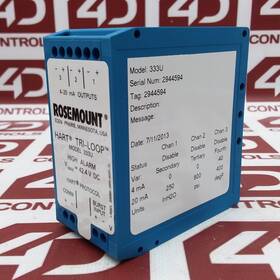
( Brand: Emerson ), ( Manufacturer Part Number: 333U ), ( Type: Signal Converters )
Review EMERSON Signal Converter 11-42vdc Hart To Analog Used
The Emerson 333U Signal Converter is a high-performance, versatile analog signal converter designed to seamlessly integrate disparate industrial measurement systems while ensuring precision, reliability, and ease of use in demanding automation environments. Engineered to bridge the gap between legacy and modern instrumentation, this robust device converts analog signals in the 11 42 VDC range into a standardized HART (Highway Addressable Remote Transducer) protocol, enabling seamless communication with compatible field devices, PLCs, and SCADA systems. The 333U operates with exceptional accuracy, delivering a linear conversion of input signals with minimal drift or error, making it ideal for applications requiring precise process monitoring and control. Its compact yet durable design features a rugged metal enclosure that protects against harsh industrial conditions, including temperature fluctuations, vibration, and moisture, ensuring long-term reliability in environments such as oil and gas, chemical processing, water treatment, and manufacturing facilities.
At the heart of the 333U s functionality is its ability to handle a wide range of analog inputs, including 4 20 mA, 0 20 mA, 0 200 mA, and 0 10 VDC signals, in addition to its primary 11 42 VDC capability, making it a flexible solution for diverse signal conditioning needs. The device supports HART communication at a standard 1.2 k loop impedance, allowing for bidirectional data exchange, including device diagnostics, calibration adjustments, and parameter configuration directly from a compatible HART communicator or field device. This two-way communication capability enhances troubleshooting and maintenance efficiency, as operators can remotely verify signal integrity, monitor device health, and adjust settings without physical access to the field instrumentation.
The Emerson 333U is equipped with advanced features to optimize performance and integration within industrial networks. It includes configurable input/output options, such as selectable signal ranges and polarity inversion, allowing users to tailor the converter to specific application requirements. Additionally, the device supports multiple addressing schemes, enabling multiple 333U units to coexist on the same HART network without interference, which is particularly advantageous in large-scale installations. For enhanced security and data integrity, the converter incorporates built-in diagnostics and error reporting, alerting operators to potential issues such as signal faults, communication errors, or power supply anomalies before they escalate into operational disruptions.
Installation and configuration of the Emerson 333U are streamlined through its user-friendly interface and comprehensive documentation. The device features clearly labeled terminals for easy wiring of input and output signals, with color-coded connectors and clear markings to minimize installation errors. Configuration is typically performed via a HART communicator or through integration with a higher-level control system, where parameters such as signal scaling, units of measurement (e.g., pressure, temperature, flow), and communication baud rates can be customized. Emerson s reputation for reliability and innovation ensures that the 333U adheres to stringent industry standards, including compliance with HART Protocol Version 7 and compatibility with major automation platforms, ensuring seamless interoperability with existing infrastructure.
Whether deployed in a critical process control application or as part of a larger instrumentation upgrade, the Emerson 333U Signal Converter delivers a robust, high-precision solution for converting and transmitting analog signals over HART networks. Its combination of technical excellence, adaptability, and ease of use makes it an indispensable tool for engineers and technicians seeking to enhance the accuracy, efficiency, and connectivity of their industrial automation systems. By reducing signal conversion errors, simplifying diagnostics, and enabling seamless integration with modern control architectures, the 333U helps organizations achieve greater operational resilience and performance in their process industries.
The Emerson 333U Signal Converter (11-42V DC to HART analog) is a device designed to convert a standard 11-42V DC signal into a HART-compatible analog signal, enabling communication with HART-enabled devices. Below is a detailed breakdown of its pros and cons, followed by a conclusion and recommendation.
---
### **Pros of the Emerson 333U Signal Converter**
1. **Compatibility with HART Protocol**
The device supports the HART (Highway Addressable Remote Transducer) protocol, which allows for two-way communication between field instruments and control systems. This enables advanced diagnostics, calibration, and configuration without physical access to the sensor. HART is widely used in industrial automation, particularly in process control environments.
2. **Wide Input Voltage Range**
The 11-42V DC input range is compatible with many existing industrial systems that use this voltage level for analog signals. This makes it a versatile choice for retrofitting or integrating with legacy systems.
3. **Enhanced Diagnostics and Monitoring**
HART communication provides real-time diagnostics, such as device health, fault detection, and parameter adjustments. This can reduce downtime and improve system reliability by alerting operators to potential issues before they escalate.
4. **Compatibility with Emerson s Ecosystem**
As part of Emerson s product line, the 333U is designed to work seamlessly with other Emerson devices, such as Rosemount transmitters, control systems, and software platforms like AMS Suite. This integration simplifies setup, maintenance, and troubleshooting.
5. **Rugged and Reliable Build**
Emerson products are generally built to withstand harsh industrial environments, including temperature fluctuations, vibration, and moisture. The 333U is likely to be durable and long-lasting, reducing the need for frequent replacements.
6. **Easy Installation and Configuration**
The device is designed for straightforward installation, often requiring minimal wiring and configuration. Emerson typically provides clear documentation and tools (e.g., HART communicators) to simplify setup.
7. **Support for Mixed-Signal Systems**
In environments where some devices use 4-20mA signals and others require HART, the 333U can bridge the gap, allowing for a unified communication framework.
8. **Energy Efficiency**
HART communication is typically low-power compared to other digital protocols, and the device itself is designed to operate efficiently within its specified voltage range.
9. **Future-Proofing**
HART is a mature protocol with ongoing support, and Emerson continues to update its software and firmware to ensure compatibility with modern systems. This reduces the risk of obsolescence.
10. **Reduced Cabling Complexity**
By converting a simple analog signal to a HART signal, the device can reduce the number of wires needed in complex systems, simplifying cabling layouts.
---
### **Cons of the Emerson 333U Signal Converter**
1. **Cost**
The 333U is a specialized device, and its price may be higher than generic analog signal converters or simple isolators. For small-scale applications, the cost-benefit ratio might not justify its use.
2. **Dependency on HART Infrastructure**
To fully utilize the HART features (e.g., diagnostics, two-way communication), the system must already have HART-enabled devices and a compatible control system (e.g., PLC, DCS). If the existing system lacks HART support, the converter s advanced features may not be usable.
3. **Limited Output Options**
The 333U converts 11-42V DC to HART but does not support other common analog outputs like 4-20mA. If the system requires multiple signal types, additional converters may be needed.
4. **Potential Latency in Communication**
While HART is robust, it operates over analog lines and may introduce slight delays compared to dedicated digital communication protocols (e.g., Foundation Fieldbus or Profibus). For high-speed applications, this could be a minor drawback.
5. **Training and Expertise Required**
Proper configuration and troubleshooting of HART devices often require specialized knowledge. Operators or technicians may need training to fully leverage the device s capabilities, which could add to operational costs.
6. **Compatibility Issues with Non-Emerson Devices**
While Emerson devices are generally well-integrated, there may be occasional compatibility issues when interfacing with non-Emerson HART devices. Testing may be required to ensure seamless operation.
7. **Physical Space Requirements**
The 333U, like many industrial converters, may require dedicated mounting space in control panels or junction boxes. In space-constrained environments, this could be a limitation.
8. **Potential for Signal Noise**
HART communication is susceptible to electromagnetic interference (EMI) and noise, which can affect signal integrity. Proper shielding and grounding may be necessary to mitigate this issue.
9. **Licensing or Software Costs**
While the hardware itself may be affordable, accessing advanced features (e.g., diagnostics, calibration tools) might require additional software licenses or subscriptions, adding to the total cost of ownership.
10. **Obsolescence Risk**
Although HART is widely used, newer protocols like WirelessHART or FOUNDATION Fieldbus may eventually replace it in some applications. While unlikely in the near term, this could be a consideration for long-term planning.
---
### **Conclusion**
The Emerson 333U Signal Converter is a robust and feature-rich device ideal for industrial applications where HART communication is required or beneficial. Its ability to convert 11-42V DC signals to HART enables advanced diagnostics, improved system reliability, and seamless integration with Emerson s ecosystem. The device s durability, ease of installation, and compatibility with existing systems make it a strong choice for process control environments.
However, the converter s higher cost, dependency on HART infrastructure, and the need for specialized knowledge to fully utilize its features may not make it the best fit for all applications. For systems that already use HART or require the advanced capabilities it provides, the 333U is a worthwhile investment. For simpler or cost-sensitive applications, a generic analog converter or isolator might suffice.
---
### **Recommendation**
**Buy the Emerson 333U Signal Converter if:**- Your system already uses or plans to adopt HART communication.
- You require advanced diagnostics, remote configuration, or two-way communication with field devices.
- You are working with Emerson or Rosemount transmitters and need seamless integration.
- The benefits of HART (e.g., reduced downtime, improved monitoring) outweigh the additional cost.
- Your environment is industrial and requires a rugged, reliable device.
**Avoid or Consider Alternatives if:**- Your system does not use HART and lacks the infrastructure to support it.
- You are working with a tight budget and can achieve your goals with a simpler, lower-cost converter.
- Your application does not require the advanced features of HART (e.g., basic 4-20mA conversion is sufficient).
- You anticipate switching to newer protocols (e.g., WirelessHART) in the future, making the 333U potentially obsolete.
For most industrial process control applications where HART is either already in use or planned, the Emerson 333U is a sound investment. However, always evaluate your specific requirements and compare it with other options to ensure it aligns with your long-term goals.
Details:
Condition: Used Item - All used products are guaranteed to be working but may show signs of use. Is Emerson 333U not the part you are wanting. For example, Programmable Logic Controllers PLC's, Distributed Control Systems DCS's, Human Machine Interface HMI's, Variable Speed Drives VSD's, Power Supplies, Pressure Transmitters and everything in between. 333U Emerson Signal Converter, 11-42VDC, Hart To Analog, Teri Loop Module.
Shipping: Shipping cost: is quoted as part of the sale.
part #: 333u prices
- $1349.00-$1763.36
specifications automationjack:
- brand: Emerson
- mpn: 333u
- type: Signal Converters
payments automationjack:
- other
- credit card: Discover
- wallet: Apple-pay
offer automationjack:
- quantity: 1
- best offers: True
- options: Ship-to-home
- started: April 23, 2026
- availability: In Stock
- sold: 0
shipping automationjack:
- transit: 5-10 Days
- service: Standard
- type: Fixed
- class: Standard
- cost: $0.00
general automationjack:
- condition: Used
- Business Industrial > Industrial Automation Motion Controls > Other Automation Equipment
returns automationjack:
- policy: Returns Accepted
- method: Money back
- paid by: Seller
- time: 60 Days
seller automationjack:
- city: Denver, Colorado
- # reviews: 886
- rating: 98.7%
Emerson 333U Is Similar To:
- Emerson 101-135-067r Branson Ultrasonic Welder Transducer Converter (35.2% similar) No questions asked. Power adapters, power cords, accessories, etc. Fast and free shipping you're already purchasing the item. R2V3 functional: f6 - like new. Testing performed: working spare or pulled from working environment. Rest assured that you're getting a good deal when purchasing with us. ...(September 10th, 2024)
- Liebert 02-796913-00 Emerson 0279691300 Used (28.8% similar) All products are guaranteed to be working but may show signs of use if purchasing a used product. Call to use a shipping service other than the ones listed. Sells new and surplus product develops channels to purchase such. Packaging and handling: items are safely eds packaged in custom shipping ...(October 28th, 2024)
- Emerson M210rgb14 Used And Tested Ct Speed Regulator 75kw 210a (26.7% similar) Part #: Emerson M210RGB14 for sale...(November 19th, 2024)
- Emerson Ombjb24 Omb-jb24 Omb Series Oil Management Control Used 24 Volt Ac (39.4% similar) Used Emerson climate technologies oil level control system. 24 volt ac applied to unit, powers up, solenoid lights all function...(December 3rd, 2024)
- Emerson Bristol Babcock 396897-02-9 Cw Micro Mio With Ao 396897029 B Used (32.1% similar) Condition is used, in manufacturers original packaging. 1 cw micro moi 4AI, 2HSC, 6DI/DO with AI daughter board local term led. Bristol 396897-02-9 cw micro moi w/AI 396897029 b new open box:: included. P/n 396897-02-9 series 46 ma 3.3VDC...(January 31st, 2025)
- White Rodgers 70-117224-5 Emerson 701172245 Used (31.5% similar) All products are guaranteed to be working but may show signs of use if purchasing a used product. Call to use a shipping service other than the ones listed. Packaging and handling: items are safely eds packaged in custom shipping cartons for protection. Sells new and surplus product develops ...(February 3rd, 2025)
- Emerson 417511g4 Terminal Assembly Rev.5 Used (38.8% similar) Emerson terminal assembly 417511G4 REV.5 used: 50.00: used AcDelco 27J5-15 us doc...(February 15th, 2025)
- Alco Controls Ps2-y7k Emerson Ps2y7k Used (29.7% similar) Comes with a 30 day warranty. Shipping requirements. Used, in great working shape and good cosmetic condition. It was pulled from a working environment and is guaranteed to be in good order...(February 19th, 2025)
- Fisher Rosemount 8732est1a1n0 Emerson Used (25.5% similar) Packaging and handling: items are safely eds packaged in custom shipping cartons for protection. Part number 8732EST1A1N0. All products are guaranteed to be working but may show signs of use if purchasing a used product. Call to use a shipping service other than the ones listed. Sells new and ...(April 8th, 2025)
- Liebert 02-790811-00 Emerson 0279081100 Used (30.8% similar) Packaging and handling: items are safely eds packaged in custom shipping cartons for protection. Call to use a shipping service other than the ones listed. Sells new and surplus product develops channels to purchase such. All products are guaranteed to be working but may show signs of use if ...(May 5th, 2025)
- Branson 101-135-067 Emerson 4 Th 4th101135067 Used (30.9% similar) Part number 4 Th 101-135-067. Call to use a shipping service other than the ones listed. All products are guaranteed to be working but may show signs of use if purchasing a used product. Packaging and handling: items are safely eds packaged in custom shipping cartons for protection. Sells new and ...(May 28th, 2025)