SCHROFF 33000-470 Vme Monolithic Circuit Board 10-SLOT T162815
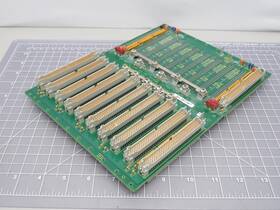
( Brand: Schroff ), ( Manufacturer Part Number: 33000-470 ), ( Part Type: Circuit Board )
Review SCHROFF Vme Monolithic 10-slot Circuit Board
The **Schroff 33000-470 VME Monolithic 10-Slot Circuit Board** (part number T162815) is a high-performance, industrial-grade chassis designed to deliver uncompromising reliability and flexibility for demanding embedded computing applications. Part of Schroff s renowned **33000 Series**, this monolithic VME (Versa Module Europa) enclosure combines robust construction with advanced thermal management to ensure optimal operation in harsh environments. The **10-slot configuration** provides ample space for a wide range of VME-compatible modules, including single-width, double-width, and even full-height cards, making it ideal for systems requiring high-density processing, data acquisition, or real-time control. Constructed from **high-strength, corrosion-resistant materials**, the chassis features a **fully shielded design** to minimize electromagnetic interference (EMI) and radio frequency interference (RFI), ensuring clean signal integrity for critical applications such as aerospace, defense, medical imaging, industrial automation, and test and measurement systems.
At its core, the **33000-470** incorporates a **monolithic backplane**, a proprietary Schroff innovation that eliminates the need for separate backplane modules, reducing complexity and improving signal integrity across all slots. This design enhances reliability by minimizing potential failure points while maintaining full VMEbus compliance, including support for **P2/P3, P1/P2, and P1/P3** module configurations. The **10-slot architecture** allows for scalable expansion, accommodating everything from basic I/O modules to high-performance FPGA accelerators, DSPs, and memory cards, all while maintaining a compact footprint. The **modular power distribution system** ensures consistent voltage delivery across all slots, even under heavy load conditions, further enhancing system stability.
Thermal management is a key consideration in the **33000-470**, with **active cooling options** available to dissipate heat efficiently in high-power applications. The chassis is engineered to support **fan-based cooling systems**, including Schroff s **33000 Series fans**, which are designed to operate silently and reliably in extended temperature ranges. Additionally, the **ventilation slots** are strategically placed to optimize airflow, reducing the risk of thermal throttling and prolonging the lifespan of sensitive components. For applications requiring even greater thermal performance, the **33000-470** can be integrated with **liquid cooling solutions**, ensuring peak performance in extreme environments.
The **33000-470** also excels in **mechanical robustness**, featuring a **fully enclosed, dust-proof design** with **gasketed lids** to prevent contamination from debris, moisture, or corrosive agents. The **locking mechanism** ensures secure closure, protecting internal components from accidental damage during transport or operation. The **front panel** is designed with **modular I/O access**, allowing for easy integration of **Schroff s proprietary connectors** or third-party interfaces, while the **rear panel** provides **standard VMEbus connectors** for seamless module integration. The **mounting options** are equally versatile, with **rack-mountable or freestanding configurations** available, making it adaptable to a variety of deployment scenarios, from laboratory setups to rugged field installations.
Beyond its technical specifications, the **33000-470** is built to meet **industry-leading standards**, including **IP40 protection rating** for basic environmental resistance, though additional sealing options can be specified for higher protection levels. It is fully compliant with **VME64x standards**, ensuring backward compatibility with legacy systems while supporting next-generation high-speed data transfer requirements. The **33000 Series** is also **CE, FCC, and RoHS compliant**, making it suitable for global deployment without additional certification hurdles. Schroff s reputation for **long-term product support** further enhances its value, as users can rely on ongoing availability of spare parts, documentation, and technical assistance for decades.
In summary, the **Schroff 33000-470 VME Monolithic 10-Slot Circuit Board (T162815)** is a **high-end, mission-critical chassis** that combines **unmatched reliability, thermal efficiency, and modular flexibility** into a single, compact package. Whether deployed in **aerospace guidance systems, medical diagnostics, industrial automation, or high-performance computing**, this enclosure delivers the **durability, performance, and scalability** required to meet the most stringent operational demands. With its **proprietary monolithic backplane, EMI/RFI shielding, and robust construction**, it stands as a **cornerstone solution** for engineers and system integrators seeking a **future-proof VME platform** that balances power, precision, and longevity.
The **Schroff 33000-470 VME monolithic 10-slot circuit board** is a high-end, full-height, full-width (FHFW) VME backplane designed for demanding applications in aerospace, defense, medical imaging, and industrial automation. Below is a detailed analysis of its pros and cons, followed by a conclusion and recommendation.
---
### **Pros**
1. **High Performance and Reliability**
The 33000-470 is a **monolithic backplane**, meaning it is a single, rigid structure without modular sections, which reduces signal integrity issues and improves mechanical stability. This design minimizes backplane flexing, which is critical for high-speed data transfers (e.g., PCIe, 64-bit/66 MHz VME) and high-frequency signals. It is built to handle **high-density, high-speed applications** with minimal signal degradation.
2. **Full-Height, Full-Width (FHFW) Compatibility**
The backplane supports **full-height, full-width VME modules**, allowing for maximum slot utilization and the integration of high-performance cards (e.g., FPGAs, high-speed ADCs/DACs, or multi-Gbps Ethernet). This is ideal for systems requiring maximum throughput and processing power.
3. **Advanced Signal Integrity Features**
- **Differential signaling** for critical buses (e.g., VME64x, PCIe) to reduce noise and crosstalk.
- **Controlled impedance traces** to ensure signal integrity at high frequencies.
- **Ground planes and shielding** to minimize electromagnetic interference (EMI) and radio-frequency interference (RFI), which is essential in aerospace and medical environments.
- **Stiffening ribs** to prevent backplane flexing under vibration or thermal stress.
4. **Mechanical Robustness**
The monolithic design is **vibration-resistant**, making it suitable for **aerospace, defense, and rugged industrial applications**. It is often used in systems that must withstand **G-forces, shock, and thermal cycling** (e.g., military avionics, satellite systems, or medical imaging equipment).
5. **Backward and Forward Compatibility**
- Supports **VME64x** (64-bit/66 MHz) as well as legacy **VME32** modules, providing flexibility for mixed-system deployments.
- Compatible with **PCIe** (via add-on cards) and other high-speed interfaces, allowing for future-proofing.
- Works with **Schroff s proprietary connectors** (e.g., **T162815**), which are known for reliability in harsh environments.
6. **Thermal Management**
The backplane is designed to **dissipate heat efficiently**, often featuring **heat sinks or thermal vias** to prevent overheating in high-density systems. This is critical for long-term reliability in embedded or industrial applications.
7. **Modular and Scalable**
While monolithic, the 10-slot configuration allows for **customizable slot assignments** (e.g., dedicating slots for specific functions like FPGA, storage, or I/O). This scalability makes it adaptable to various system architectures.
8. **Industry-Standard Compliance**
- Meets **MIL-STD-883, MIL-STD-461, and other ruggedization standards**, ensuring compliance with military and aerospace requirements.
- Often used in **DO-160G (avionics) and IEC 61000-4-2 (EMI/ESD) compliant** systems.
9. **Long-Term Availability**
Schroff is a **long-standing manufacturer** in the embedded and industrial computing space, and their high-end backplanes like the 33000-470 are **less likely to become obsolete** compared to proprietary or niche solutions. This ensures **spare parts availability** for legacy systems.
10. **Support for High-Speed I/O**
- Supports **10G Ethernet, Fibre Channel, and other high-speed serial interfaces** when paired with compatible modules.
- Can integrate with **PCIe-based accelerators** (e.g., FPGA cards) for real-time processing.
---
### **Cons**
1. **High Cost**
The 33000-470 is a **premium product**, and its price reflects its **high performance, ruggedness, and signal integrity features**. For budget-conscious projects, especially in non-critical applications, this may be prohibitive. Costs can range from **$5,000 to $15,000 ** depending on quantity, customization, and additional features (e.g., PCIe add-ons).
2. **Complexity in Design and Integration**
- **Signal integrity tuning** may be required when integrating high-speed modules (e.g., FPGAs, ADCs) to ensure optimal performance.
- **Thermal management** must be carefully planned to prevent overheating in dense configurations.
- **Mechanical constraints** (e.g., weight, size) may limit integration into space-constrained systems.
3. **Limited Slot Flexibility**
While it supports 10 slots, the **monolithic design does not allow for hot-swapping** of modules (unlike some modular backplanes). This means downtime may be required for maintenance or upgrades.
4. **Vendor Lock-In Risk**
- Schroff s proprietary connectors (e.g., **T162815**) may require **custom cabling or adapters** if third-party modules are used.
- While Schroff is reliable, **long-term support** depends on the vendor s business continuity, which could be a concern for mission-critical systems.
5. **Weight and Size**
The monolithic construction makes the backplane **heavier and bulkier** than some modular alternatives. This may be a drawback in **portable or aerospace applications** where weight is a critical factor.
6. **Learning Curve for Engineers**
- Designing with this backplane requires **experience in high-speed PCB layout, signal integrity, and VME/PCIe integration**.
- Engineers unfamiliar with Schroff s ecosystem may need additional training or support.
7. **Potential for Overkill in Low-Speed Applications**
If the application does not require **high-speed data transfer, ruggedization, or advanced signal integrity**, a simpler (and cheaper) backplane (e.g., a standard VME64x or even a PCIe-based solution) may suffice.
8. **Limited DIY Customization**
Unlike some modular backplanes, **custom slot assignments or hybrid interfaces** (e.g., mixing VME with other buses) are not as straightforward. Customization often requires working closely with Schroff s engineering team.
9. **Power Requirements**
High-performance VME systems often require **robust power supplies** capable of handling **high current draw** from FPGAs, GPUs, or other power-hungry modules. This adds to the overall system cost.
10. **Depreciation Risk**
While Schroff products are durable, **rapid advancements in computing** (e.g., FPGA acceleration, NVMe storage) may make some configurations **less future-proof** than modular or hybrid architectures.
---
### **Conclusion**
The **Schroff 33000-470 VME monolithic 10-slot backplane** is a **high-end, mission-critical solution** best suited for applications where **reliability, signal integrity, and ruggedness** are non-negotiable. It excels in **aerospace, defense, medical imaging, and industrial automation**, where high-speed data processing, vibration resistance, and long-term stability are essential.
However, its **high cost, complexity, and overkill for low-end applications** make it less ideal for **cost-sensitive or general-purpose computing projects**. Engineers must weigh the **performance benefits against the investment** and ensure their team has the expertise to integrate it effectively.
---
### **Recommendation**
**Buy the Schroff 33000-470 if:**1. You are developing a **high-performance, ruggedized system** (e.g., military avionics, satellite ground stations, medical imaging, or industrial control systems).
2. Your application requires **VME64x, PCIe, or high-speed serial interfaces** with **minimal signal degradation**.
3. **Signal integrity, EMI/ESD protection, and vibration resistance** are critical (e.g., aerospace, defense, or harsh industrial environments).
4. You need **long-term reliability and spare parts availability** for legacy systems.
5. Your budget can accommodate a **premium backplane solution** without compromising on performance.
**Avoid the Schroff 33000-470 if:**1. Your project is **cost-sensitive** and a standard VME64x or PCIe-based backplane would suffice.
2. You lack **experience in high-speed PCB design or VME/PCIe integration**.
3. Your system does not require **full-height, full-width modules** (a smaller backplane may be more efficient).
4. **Weight, size, or thermal constraints** are critical, and a modular or hybrid solution would be more appropriate.
5. You are developing a **prototype or low-volume project** where the upfront cost is prohibitive.
**Alternatives to Consider:**- **Schroff 33000-460 (8-slot monolithic VME64x):** A slightly less expensive option if you don t need 10 slots.
- **VME9
Details:
We proudly sell hard-to-find parts, components, and machines to makers manufacturers. Glad you stopped by.
part #: 33000470 price
- $289.99
specifications automationjack:
- brand: Schroff
- mpn: 33000-470
- part type: Circuit Board
offer automationjack:
- best offers: True
- started: June 2, 2026
- quantity: 2
- options: Ship-to-home
- sold: 0
- availability: In Stock
seller automationjack:
- # reviews: 22313
- city: El Paso, Texas
- rating: 99.7%
payments automationjack:
- credit card: Discover
- other
- wallet: Google-pay
general automationjack:
- Business Industrial > Industrial Automation Motion Controls > Other Automation Equipment
- condition: Used
shipping automationjack:
- cost: $13.70
- type: Calculated
- carrier: UPS
- class: Standard, Expedited, One-day
- service: UPS Ground, UPS 2nd Day Air, UPS 3 Day Select, UPS Next Day Air
- transit: 3-8 Days
returns automationjack:
- paid by: Seller
- time: 30 Days
- method: Money back
- policy: Returns Accepted
Schroff 33000-470 Is Similar To:
- Schroff 60800-489 3-slot Vsb-bus Piggy-back Backplane (43.5% similar) Are not included with this equipment unless pictured and/or listed in the above. Fast and hassle-free...(April 3rd, 2026)