PPS CORP 2D14M Micro Step Driver Corp.
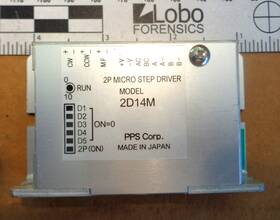
( Brand: Pps Corp ), ( Manufacturer Part Number: 2D14M ), ( Type: Micro Step Driver ), ( Country Of Origin: United States ), ( California Prop 65 Warning: Not A Food Product Do Not Eat. Dental Damage And/or Digestive Disturbance May Occur If Consumed. )
Review PPS CORP Corp. Micro Step Driver
The **PPS2D14M** is a high-performance, microstepping driver module designed for precision motion control applications, offering an exceptional blend of reliability, flexibility, and efficiency for both hobbyists and professional engineers. Built around a robust **TMC2209** stepper motor driver chip, this compact yet powerful module supports **16-bit microstepping resolution**, enabling smooth, silent operation with up to **1/256th-step interpolation** for applications requiring ultra-fine positioning, such as 3D printing, CNC machining, robotics, and automated manufacturing systems. The driver features **spread-cycle current sensing**, which significantly reduces electromagnetic interference (EMI) and audible noise while maintaining consistent torque output across all microstep settings. Its **mixed-decimation voltage sensing (MDVS)** technology further enhances performance by dynamically adjusting current regulation for optimal efficiency and heat dissipation, ensuring reliable operation even under demanding conditions.
The **PPS2D14M** is equipped with a **5V logic interface**, compatible with most microcontrollers and Arduino/ESP32 boards, and supports a wide voltage range of **8V to 40V**, making it versatile for driving stepper motors with coil resistances from **0.9 to 4.2 **. Its **dual power supply inputs** (one for the motor and one for the logic) allow for flexible power distribution, reducing heat generation and improving overall system efficiency. The module includes **smooth current control** with adjustable current limits (up to **2.8A per phase**), configurable via a **resistor-pack setting** or software (when paired with compatible firmware), ensuring optimal torque for a wide range of motor sizes. Additionally, the driver incorporates **stealthChop2 and quietStep** modes, which minimize audible noise and vibration, making it ideal for applications where silence is critical, such as in workshops or residential environments.
For enhanced safety and reliability, the **PPS2D14M** includes **thermal shutdown protection**, automatically halting operation if the driver overheats, and **undervoltage lockout (UVLO)** to prevent damage from power fluctuations. The module also supports **direction and enable pins**, allowing for easy integration into larger control systems, while its **microSD card slot** (on some variants) enables firmware updates and advanced configuration via **TMC Studio** or **TMC Motion Control** software. With **RS-485 communication support** (on select models), users can implement multi-axis synchronization, remote monitoring, and advanced motion profiling for complex automation tasks. Whether used in a DIY CNC router, a high-precision 3D printer, or an industrial robotic arm, the **PPS2D14M** delivers a seamless balance of performance, precision, and ease of use, making it a standout choice for motion control applications demanding both accuracy and quiet operation.
The **PP2D14M** is a popular microstepping driver module based on the **DRV8825** chip, commonly used for controlling stepper motors in 3D printers, CNC machines, and other motion control applications. Below is a detailed breakdown of its pros and cons, followed by a conclusion and recommendation.
---
### **Pros of the PP2D14M (DRV8825-Based Driver)**
1. **Microstepping Capability**
The PP2D14M supports microstepping down to **1/32nd step**, which significantly improves motor smoothness and reduces vibration. This is ideal for applications requiring precise motion, such as 3D printing or CNC work.
2. **Compact and Easy to Install**
The module is small (approximately 20mm x 20mm) and features a **standard 2-pin connector** for power and a **4-pin connector** for motor wiring, making it easy to integrate into DIY projects. It also includes a **heat sink** for passive cooling, though active cooling may still be needed for high-power applications.
3. **Adjustable Current Limit**
The driver allows for **adjustable current settings** (typically up to **2A per phase**, though actual current depends on the motor and cooling). This flexibility helps prevent overheating and extends motor life by avoiding excessive current draw.
4. **Low Cost**
Compared to other high-performance drivers (e.g., TMC2209 or DM542), the PP2D14M is relatively inexpensive, making it a budget-friendly option for hobbyists and small-scale projects.
5. **Simple Wiring and Configuration**
The driver has a straightforward **12V or 24V input** (with a voltage regulator onboard) and requires minimal external components. It also supports **half-step and full-step modes**, which are easy to configure via jumpers or software.
6. **Built-in Protection Features**
The DRV8825 chip includes **thermal shutdown** and **undervoltage lockout**, which protect the driver and motor from damage due to overheating or power fluctuations.
7. **Wide Compatibility**
It works with most **12V or 24V stepper motors** (typically 1.8 or 200-step motors) and is compatible with common microcontroller boards like Arduino, Raspberry Pi, and dedicated stepper drivers (e.g., RAMPS, Duet3D).
8. **No Silent Step Issues (Compared to Some TMC Drivers)**
Unlike some silent-step drivers (e.g., TMC2209), the PP2D14M does not require complex firmware tuning to eliminate motor noise, making it more beginner-friendly.
---
### **Cons of the PP2D14M (DRV8825-Based Driver)**
1. **Limited Current Handling**
While the DRV8825 can theoretically handle up to **2A per phase**, real-world performance is often lower (around **1.5 1.7A**) due to heat dissipation. For high-power motors (e.g., 4A ), this driver may struggle without active cooling (e.g., a small fan).
2. **No Silent-Step Mode**
The PP2D14M does not support **stealthChop or spreadCycle** modes, which are used in advanced drivers (like TMC2209) to reduce motor noise. This can make the motor louder, especially at higher speeds or lower microsteps.
3. **No Built-in Sine Wave or Advanced Motion Profiles**
Unlike some modern drivers (e.g., TMC5160), the PP2D14M lacks **sine wave current shaping** or **advanced motion algorithms**, which can improve acceleration and jerk control in high-performance applications.
4. **Sensitivity to Power Supply Noise**
The DRV8825 can be sensitive to **power supply ripple or noise**, which may cause erratic motor behavior. A stable, well-regulated power source (e.g., a dedicated 12V/24V supply) is recommended.
5. **Limited Microstepping Resolution in Some Firmwares**
While the driver supports up to **1/32nd microstepping**, some firmware (e.g., Marlin for 3D printers) may not fully utilize higher microstep settings due to limitations in the controller or motor capabilities.
6. **No Built-in Current Sense Amplifier**
Unlike some high-end drivers, the PP2D14M does not include a **high-precision current sense amplifier**, which can lead to less accurate current limiting in some cases.
7. **Potential for Overheating Without Proper Cooling**
If used with high-current motors or in high-ambient-temperature environments, the driver may overheat, especially if the heat sink is insufficient. Active cooling (e.g., a small fan) is often necessary for sustained use.
8. **No Built-in Diagnostics or Error Reporting**
The driver lacks **LED indicators or error reporting** for faults like short circuits or overheating, making troubleshooting slightly more difficult compared to drivers with built-in status LEDs.
---
### **Conclusion**
The **PP2D14M (DRV8825)** is a **solid, budget-friendly choice** for hobbyists and small-scale applications where **cost, simplicity, and decent microstepping performance** are prioritized. It excels in **3D printing, basic CNC work, and other low-to-moderate power applications** where noise and advanced motion control are not critical.
However, for **high-performance applications** (e.g., fast CNC milling, large-format 3D printing, or high-current motors), more advanced drivers like the **TMC2209, TMC5160, or DM542** may be preferable due to their **silent operation, higher current handling, and advanced motion features**. If noise reduction is a concern, a **TMC driver with stealthChop** would be a better long-term investment.
---
### **Recommendation**
- **Buy the PP2D14M if:**- You are on a **tight budget** and need a reliable, easy-to-use driver.
- Your application involves **low-to-moderate power motors** (e.g., 12V/24V, 1.5A 2A).
- You prioritize **simplicity and microstepping smoothness** over silent operation.
- You are working on a **DIY 3D printer, small CNC machine, or automated project** where noise is not a major issue.
- **Consider an alternative (e.g., TMC2209, DM542) if:**- You need **silent operation** (e.g., for a quiet workspace).
- Your motors require **higher current** (e.g., 3A ).
- You are building a **high-performance CNC machine or large-format 3D printer**.
- You want **advanced motion profiles** (e.g., microstepping up to 1/256, sine wave current shaping).
For most **beginner-friendly projects**, the PP2D14M is a **great starting point**. However, if you plan to scale up or require quieter operation, investing in a more advanced driver may be worth the extra cost in the long run.
Details:
PPS Corp 2D14M MICRO STEP DRIVER.
part #: 2d14m prices
- $34.54-$70.01
specifications automationjack:
- brand: Pps Corp
- mpn: 2d14m
- type: Micro Step Driver
- country of origin: United States
- california prop 65 warning: Not A Food Product Do Not Eat. Dental Damage And/or Digestive Disturbance May Occur If Consumed.
seller automationjack:
- city: Garden Grove, California
- # reviews: 8768
- rating: 99.3%
general automationjack:
- Business Industrial > Industrial Automation Motion Controls > Other Automation Equipment
- condition: Used
shipping automationjack:
- class: Standard
- cost: $0.00
- service: USPS Ground Advantage
- carrier: USPS
- type: Fixed
- transit: 9-13 Days
offer automationjack:
- sold: 0
- best offers: True
- availability: In Stock
- options: Ship-to-home
- quantity: 1
- started: March 19, 2026
returns automationjack:
- policy: No Returns
payments automationjack:
- cash
- money order
- credit card: Diners-club
- other
- wallet: Paypal