ALLEN-BRADLEY 1694-PM14 Automation
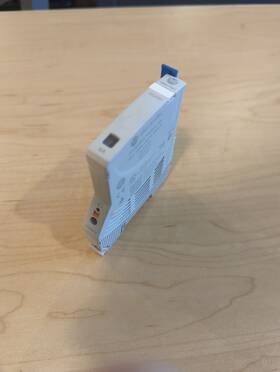
( Brand: Allen-bradley ), ( Manufacturer Part Number: 1694-PM14 )
Review ALLEN BRADLEY Used
The **Allen-Bradley 1694-PM14** is a high-performance, compact power module designed for industrial automation applications requiring robust and reliable power conversion. Part of Rockwell Automation s **PowerFlex** series, this **14 kW (19 HP) variable frequency drive (VFD)** is engineered to deliver precise control over electric motors in demanding environments, ensuring energy efficiency, extended equipment lifespan, and seamless integration into modern control systems. Built with a **PLC-compatible design**, the 1694-PM14 integrates seamlessly with Allen-Bradley s **CompactLogix, ControlLogix, and Studio 5000** platforms, enabling advanced motor control, fault diagnostics, and predictive maintenance capabilities through its **EtherNet/IP** communication interface. Its **IP20** enclosure rating provides standard protection against solid objects and dust, making it suitable for indoor applications where cleanliness and operational reliability are critical. The drive features a **wide input voltage range (200 480 VAC, 50/60 Hz)**, accommodating global power standards, while its **smooth acceleration/deceleration curves** minimize mechanical stress on connected equipment, reducing wear and tear. With **regenerative braking** and **soft-start capabilities**, the 1694-PM14 optimizes energy consumption and extends motor life by mitigating inrush currents and voltage spikes. Its **compact footprint** and **modular design** allow for easy installation in tight spaces, while the **user-friendly LCD display** provides real-time monitoring of motor speed, torque, and system status, enhancing troubleshooting efficiency. Additionally, the drive supports **multiple communication protocols**, including **DeviceNet, ControlNet, and Ethernet/IP**, ensuring compatibility with diverse automation networks. Whether deployed in **HVAC systems, conveyor belts, pumps, or industrial machinery**, the 1694-PM14 delivers **superior performance, energy savings, and long-term operational reliability**, making it an ideal choice for engineers and technicians seeking a versatile, high-efficiency power solution.
### **Pros and Cons of buying a Allen-Bradley 1694-PM14 (14-Slot Programmable Terminal)**
The **Allen-Bradley 1694-PM14** is a modular programmable terminal designed for automation applications, particularly in industrial control systems. Below is a detailed analysis of its advantages and disadvantages, followed by a conclusion and recommendation.
---
### **Pros of the 1694-PM14**
1. **Modular and Expandable Design**
- The 1694-PM14 is part of the **1694 series**, which allows for modular expansion via additional **1694-PM** slots (up to 14 in this case). This flexibility enables users to adapt the system to different control requirements without replacing the entire unit.
- Supports a variety of **input/output (I/O) modules**, including digital, analog, and special function modules, making it versatile for different automation needs.
2. **High Performance and Reliability**
- Built on **Allen-Bradley s robust industrial platform**, the 1694-PM14 is designed for harsh environments, offering **high-speed processing** and **low latency** for real-time control applications.
- Compatible with **Rockwell Automation s ControlLogix and CompactLogix platforms**, ensuring seamless integration with larger control systems.
3. **Advanced Communication Capabilities**
- Supports **EtherNet/IP**, **DeviceNet**, and **ControlNet** protocols, enabling easy integration with **PLCs, HMIs, and other industrial networks**.
- Ethernet/IP connectivity allows for **remote monitoring and diagnostics**, improving maintenance efficiency.
4. **Scalability for Growing Applications**
- The 14-slot configuration provides **future-proofing** additional modules can be added as the system requirements evolve.
- Suitable for **medium to large-scale automation projects**, such as manufacturing, process control, or building automation.
5. **Compatibility with Rockwell Software**
- Works seamlessly with **Studio 5000**, **RSLogix 5000**, and other Rockwell programming environments, reducing development time and ensuring consistency in control logic.
- Supports **structured text, ladder logic, and function block programming**, catering to different engineering preferences.
6. **Durable and Industrial-Grade Construction**
- Designed for **industrial environments**, with **wide operating temperature ranges** and **vibration resistance**, making it suitable for factories, oil & gas, and other demanding settings.
- **Redundant power supply options** (if configured) enhance system reliability.
7. **Cost-Effective for Large Installations**
- While the upfront cost may be higher than smaller terminals, the **long-term scalability and reduced need for multiple standalone devices** can make it more economical for complex systems.
- Lower total cost of ownership (TCO) due to **reduced wiring complexity** and **easier maintenance**.
---
### **Cons of the 1694-PM14**
1. **High Initial Cost**
- The **1694-PM14 is an enterprise-level device**, meaning it is **more expensive** than smaller programmable terminals (e.g., **1769-L30ER** or **1769-L32ER**).
- Additional **I/O modules, communication adapters, and programming licenses** can further increase expenses.
2. **Complexity in Setup and Configuration**
- Requires **advanced knowledge of Rockwell Automation systems** for proper installation and programming.
- **Wiring and module selection** can be time-consuming, especially for engineers unfamiliar with the platform.
- **Firmware and software updates** may require additional training or support.
3. **Overkill for Small-Scale Applications**
- If an application only requires **a few I/O points**, a **smaller PLC or PAC (Programmable Automation Controller)** (e.g., **CompactLogix L32E**) may be **more cost-effective**.
- The **1694-PM14 s size and power consumption** may not be justified for simple control tasks.
4. **Dependence on Rockwell Ecosystem**
- **Limited third-party support** compared to more open industrial platforms (e.g., **Siemens, Schneider Electric, or Beckhoff**).
- **Vendor lock-in risk** migrating to a different automation system later may require **significant rework**.
5. **Physical Size and Installation Constraints**
- The **14-slot chassis is large**, requiring **dedicated space** in control panels.
- **Mounting and wiring** may be more complex than smaller devices, increasing installation time.
6. **Potential for Redundancy in Simple Systems**
- If a system **does not require high-speed processing or extensive I/O**, a **simpler terminal (e.g., 1769-L36ER)** might suffice without the added complexity.
- **Over-engineering** can lead to **unnecessary costs** if the full capacity is not utilized.
7. **Maintenance and Troubleshooting Challenges**
- **Diagnosing issues** in a modular system can be **more complex** than in a single-unit PLC.
- **Spare parts and replacement modules** may have longer lead times compared to more common PLCs.
---
### **Conclusion**
The **Allen-Bradley 1694-PM14** is a **powerful, scalable, and high-performance programmable terminal** ideal for **large-scale industrial automation projects** where **modularity, speed, and integration with Rockwell s ecosystem** are critical. It excels in **complex control systems, manufacturing lines, and process automation** where **expansion and reliability** are priorities.
However, for **smaller applications, budget-conscious projects, or non-Rockwell environments**, the **1694-PM14 may be overkill**, leading to **higher costs and unnecessary complexity**. In such cases, **smaller PLCs (e.g., CompactLogix, Micro800, or even non-Rockwell alternatives)** would be more appropriate.
---
### **Recommendation**
- **Buy the 1694-PM14 if:**- You are **already using Rockwell Automation s ControlLogix/CompactLogix** and need **expansion or a dedicated terminal**.
- Your application requires **high-speed I/O, multiple communication protocols, or a modular architecture**.
- You anticipate **future growth** in control requirements and want a **scalable solution**.
- You operate in an **industrial environment** where **reliability and redundancy** are essential.
- **Avoid the 1694-PM14 if:**- Your project is **small-scale** (fewer than 50 I/O points) and a **smaller PLC (e.g., 1769-L32ER, 1769-L36ER, or Micro800)** would suffice.
- You are **not committed to Rockwell Automation** and prefer **open or third-party compatible systems**.
- **Budget constraints** make the **upfront cost prohibitive**, and a **more cost-effective alternative** (e.g., Siemens S7-1200, Schneider M580) is available.
- Your team lacks **experience with Rockwell s programming environment**, as training may be required.
**Final Verdict:**The **1694-PM14 is a premium choice for industrial automation professionals** who need **high performance, scalability, and Rockwell integration**. For most other applications, **smaller or more cost-efficient alternatives** should be considered first. Always **evaluate long-term needs** before committing to such a high-end solution.
Details:
These parts have not been tested.
part #: 1694pm14 prices
- $34.99-$58.00
specifications automationjack:
- brand: Allen-bradley
- mpn: 1694-pm14
seller automationjack:
- city: Byron Center, Michigan
- rating: 0.0%
- # reviews: 3
returns automationjack:
- policy: No Returns
general automationjack:
- condition: Used
- Business Industrial > Industrial Automation Motion Controls > Other Automation Equipment
offer automationjack:
- availability: In Stock
- started: May 27, 2026
- best offers: True
- sold: 0
- options: Ship-to-home
- quantity: 2
payments automationjack:
- other
- wallet: Google-pay
- credit card: Mastercard
shipping automationjack:
- type: Fixed
- carrier: UPS
- cost: $7.22
- service: UPS Ground
- transit: 3-8 Days
- class: Standard
Allen-bradley 1694-PM14 Is Similar To:
- Allen Bradley 1489-m1c020 Ser.d 1 Pole 2a Circuit Braker (47.6% similar) New - old stock inventory as pictured not in original box item comes shown and only includes what is the photos, please look over carefully prior to purchase. Allen bradley 1489-M1C020 sear.d 1 pole 2a circuit breaker. Some items may have slight cosmetic damage which is noted in the condition of ...(October 5th, 2023)
- Allen-bradley 2198-p070 Kinetix 5700 Dc Bus Fw14.001 2198p070 New (47.3% similar) Return police: it will just take you 1 minute. Please leave a telephone number for on-time delivery. 2198-P070 allen bradley kinetic 5700 dc bus FW14.001 2198P070 new dear customer, there is one things need to be noticed before placing an order...(October 8th, 2023)
- Allen-bradley Vpl-b0752f-pj12aa Allen-bradley Servo Motor For Parts Repair (38.8% similar) Please see pictures for more detail. It has not been tested. Sale includes: Allen-bradley VPL-B0752F-PJ12AA servo motor, for parts/ repair. Condition of internal components is unknown. Sorry, no other parts or accessories included. Functionality is unknown. Item has not been opened or disassembled. ...(November 10th, 2023)
- Allen-bradley 800f-x01l Contact Cartridge Bag Of 10 Sa (43.9% similar) They are new in the bag...(November 17th, 2023)
- Allen Bradley 800h-r3ha7 Selector Switch Station New (37.5% similar) It is carefully crafted with premium materials to withstand harsh conditions, ensuring that it will last for years come. The station is designed with a focus on functionality, making it easy to operate and providing you complete control over your equipment...(November 18th, 2023)
- Allen-bradley 2803-cm Series A Camera Mux Module (50% similar) Allen bradley 2803-CM series a camera mix module condition - preowned, GC1-D-MBKY...(November 19th, 2023)
- Allen Bradley 100s-c30udj13bc Motor Controller Combination Rev-starte S 146393 (31.8% similar) Allen bradley 100S-C30UDJ13BC motor controller combination rev-starter and base, 24 CDC. Manufacturer part number: 100S-C30UDJ13BC...(November 26th, 2023)
- Allen Bradley 800a-h2bw Ser B Maintained Selector Switch Nos Free Fast Ship (31.1% similar) Part #: allen bradley 800A-H2BW for sale...(December 20th, 2023)
- Guardmaster Ltd 440k-t11341 Allen Bradley 440kt11341 Series B Safety Interlock Switch (28.3% similar) Allen bradley 440K-T11341, 440KT11341, series b, safety interlock switch lock: cabinet 2 top shelf 1210...(December 21st, 2023)
- Allen-bradley 2198-h20ck Dsl Converter Kit Sser B Fw 1.18 236757 (43.5% similar) MCSALE25X: : allen bradley 1756-IB16 sear a cat rev H01 f/w 3.2 dc input 16PT 24VDCUSED good condition may look different than photo have shelf ware BB61APD1 pd D78 item is sold as where...(January 3rd, 2024)
- Allen-bradley 4963-ds Surge Protector With Dry Contact Indication (36.6% similar) Allen bradley 4963-DS surge protector with dry contact indication, 277 vac 60 Hz, 420 vac cove, in 20,000 a, CPR 1500 v, these are unused. Offer is for all they are dirty from sitting around, but they unused...(January 8th, 2024)